“You can observe a lot just by watching” –Yogi Berra
I have become a voyeur-a silent witness-of my inner self. I can watch my thoughts, my emotions and my bodily sensations. I am a voyeur of “me”. I can watch all of “me” dispassionately, like a scientist. This is the single biggest step forward in my journey of self-discovery. One small step for the new me and one giant step for the old me. Apologies to Neal Armstrong.
I have learnt a lot about myself and the world around me just by watching my thoughts, emotions and sensations in my body. It took me many years to develop an ability to watch my thoughts and emotions without judging them. It is a skill I developed through practice. Normally, I get swept up in my thoughts, one thought leads to another and another, and the mind wanders off. I had to work at breaking this habit. I had to learn to let go of a thought as soon as it appeared. I had to train myself to look at a thought as a cloud wafting through the sky, to just watch without any attachment. Slowly the thoughts stop coming.
The act of watching, non-judgmentally, quietens my mind, quells my emotions and removes tensions in my body. My mind, body and emotions become harmonized. Borrowing the language from the Vedas, my chakras become aligned and my nadis open, and I feel connected to the universe. In this state there is no “I”. There is just emptiness. I am like an empty vessel, open, spacious and accepting. And, attuned to the wisdom of the universe. Paraphrasing Yogi Berra, I observe a lot just by watching. There is no need for a guru, there is wisdom within us. There is a knowing beyond knowledge. We can access this wisdom. Unfortunately, we are not taught to get in touch with the wisdom within us. Some, like me, stumble into it, many look to religion, most never discover it.
Scientific methods cleave the observer from the observed. But the voyeur in us, or the silent witness, turns us, the observer, into the observed. Only humans have this capacity to observe themselves. I am an object to the voyeur in me that can be watched and studied “scientifically”. That is, after much practice, I am now able to watch my thoughts, feelings and sensations dispassionately and objectively. I can gather data on the workings of my mind and analyze it like a scientist. Equally importantly just by watching and witnessing the contents of my mind I change them, as Yogi Berra so astutely observed “you can observe a lot just by watching”. Quantum physics has proven that the very act of observing a phenomenon changes it.
The Vedic sages were scientists of a kind. Their method of inquiry was from the inside out. Their starting point of inquiry was their mind (and emotions). Through this process they transcended their minds and accessed “truths” that western science is just beginning to approach. The process of the sages was the inverse of the process of western science. The Vedic sages started with the subjective, the self, and discovered that the rest was a projection of the self (mind). Modern scientific methods exclude the personal, the self, from their study of the phenomenological world. Thus, western science has not yet made the connection between the subjective and the objective—the world inside and the world outside.
“Science describes accurately from outside, poetry describes accurately from inside. Science explicates, poetry implicates. Both celebrate what they describe.” Ursula K. Le Guin.[i]
The voyeur in me is a scientist. The voyeur observes and collects data on me, just like a scientist. The very act of observing “me” changes me. The practice of witnessing one’s thoughts and feelings is transformational.
This I believe:
14.We can observe the workings of our mind objectively and dispassionately. We can observe our thoughts, our emotions and our bodily sensations. We can be scientists of our own mind. I have learnt a lot about myself by observing my mind.
“The Caterpillar is the first character who really makes an effort to guide Alice on her journey. Since she’s tired of growing larger and smaller due to circumstances beyond her control, the Caterpillar teaches her to eat parts of the mushroom to control her size. Some critics, and especially people in popular culture, see the Caterpillar as a representative of drug culture since he’s smoking a hookah and shows Alice how to eat a magic mushroom. But we prefer to see the Caterpillar as a lackadaisical guru who helps Alice figure out how to control the imaginative world that she’s exploring. The Caterpillar also reminds Alice that changing in size and shape isn’t always a bad thing – after all, one day the Caterpillar will metamorphose into a butterfly, and instead of being unnerving, it will be the high point of his life.” [i]
Everyone needs a lackadaisical-hookah-smoking guru. After all, we too need to be reminded that changing isn’t always a bad thing and it could be the high point of our life. But, on the path to self- discovery the longest journey, as stated by Gary Zukav is from the head to the heart. It is akin to an emotional heart transplant. Why?
The latest findings by neuroscientists is that the seat of all passions is the amygdala, two almond shaped structures that sit on top of the brain stem. Daniel Goleman (Goleman, 2005), who popularized the concept of emotional intelligence, explains in his book that humans have two brains-the thinking brain and the emotional brain. The thinking brain is the neocortex and the emotional brain is the amygdala. If the amygdala is severed one loses the “ability to gauge the emotional significance of events”. A sad condition to have, as one becomes a robot devoid of feelings.
The Vedic sages did not have the understanding of the structure of the brain but their exploration of human emotions led them to conclude that we have three bodies-the physical body, the emotional body and the mental body. And, they came to similar conclusions as the neuroscientists that the emotional body is impulsive and acts at times without “forethought”, hijacking the mental and the physical bodies. We have all experienced instances where we have lost control and have acted in ways that we later regret. In these instances, our thinking brain is no longer in control and our emotions have taken over.
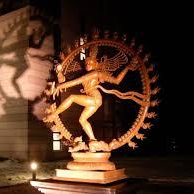
Emotions are powerful energies. In Hinduism, there is a powerful imagery of the potential energies trapped in our bodies, the imagery is of a coiled serpent. This energy is called Kundalini and it is best explained as a parable of Shiva and Shakti, two deities in Hinduism.
“Lord Shiva symbolizes consciousness and the unmovable power of the observer. He is said to have been meditating for thousands of years while Shakti danced for him. Her longing to be at one, dancing with her beloved provokes him to open one of his three eyes. She beckons for him to dance with her. He closes his eye and rests back in meditation for thousands more years, awaiting her absolute clarity that joining in harmonious union with him is her true desire. As her longing intensifies, she determines that she must dance with her Beloved Lord Shiva. At that, his three eyes open, they dance together, and all at once the universe unfolds into creation. All of nature is created as a result of their union.”
Both neuroscientists and the Vedic sages have concluded that when the emotional and the mental bodies/brains work in harmony we reach peak levels of performance. The ultimate state of being is when mind, body and heart are in perfect alignment and in harmony with nature.
“Nature is all that dances, all that moves and changes in this world. The witness or seer within each of us is Shiva and the nature of all things around us and within us is Shakti. When Shiva and Shakti are separate, spiritual awakening cannot take place. That separate state is known as a duality. The very merging of Shiva and Shakti obliterates duality and opens the spiritual river of oneness through which Kundalini flows.”[ii]
Our negative emotions are trapped energies (Shakti) seeking release. Our spiritual metamorphosing happens when we transmute our negative emotions into healing energies. It is the journey that Gary Zukav refers to as the journey from the head to the heart. I have come to think of it as a heart transplant. This emotional transformation has been the most difficult part of my journey.
I have learnt to pay attention to my negative feelings, for negative emotions draw our attention to areas in us that need to be healed. The energies trapped in our emotions are looking to be released. We can release these energies consciously or they will release themselves often causing drama in our lives. Emotions that are held back, and not released, leave am emotional scar in us.
We, often, use the analogy of a musical instrument to describe our emotional state. We say that “our heart strings were pulled”, “we are high strung”, we are “tight as a drum”, “felt played like a fiddle”, etc. There is a good reason for it, our emotions are energies in motion that create sensations in our body. Each emotion has a unique “signature movement” in our body. Anger feels different than love, sadness different from joy. We respond emotionally to life events. It is as if, life events strum our emotional strings to produce different notes in our being, Love, happiness, gratitude and awe feel as if our entire being is in tune with the harmony in nature, whereas sadness, anger, fear and disgust produce discordant notes in us.
“it is with heart one sees rightly; what is essential is invisible to the eye” Antoine de Saint-Exupery, The Little Prince.
I taught myself to watch my emotions. Emotions become objects to be watched. Watching releases blocked energy, which releases the tension in the body. I began to track my emotions every day, for eighteen months, and built a database of my emotions and my mental states and recorded how my body felt in response to an emotional charge.
To quantify my emotions, I created a 10-point rating scale, 5 point represented homeostasis for me, anything less than 5 was negative and over 5 was positive. The graph below shows the daily pattern of the state of my mind, body and emotions, over eighteen months of tracking.
On the vertical axis are the ratings and on the horizontal axis are the dates. The green line is the daily average of the ratings of the state or my mind, body and emotions. The blue line is the graph of my emotional state, the yellow my mental state and the red the state of my body.
The exact data points are not the point, it is the trends that matter. During this period, I went through many emotional ups and downs, as the lines show, but the overall trend is positive. I attribute this to the fact that through this practice I am able to cope better and have in some instances addressed the underlying causes that trigger the negative emotions in me.
I have become a scientist of my own emotions. I am able to watch my thoughts, emotions, and bodily sensations, dispassionately. I have discovered a lot about myself just by watching. As the incomparable Yogi Berra[iii] said “you can observe a lot by watching”. I learnt that by staying current with my emotions I am able to get them off my chest. I do not hold them in. They no longer fester in me becoming toxic.
I have noticed that negative emotions feel different in the body than positive ones. With negative emotions the body feels weighed down, hence the expression “I feel like I am carrying the weight of the world”. Positive emotions make my body feel buoyant, almost weightless. Not surprisingly our emotional state affects others around us. Emotions are like vibrations emanating from us and creating a field around us.
Negative emotions, in us, brings out negativity in others and positive emotions have a positive effect on others. Neurologists attribute this effect to mirror neurons in our brains. These are the “monkey see monkey do neurons”. “When I see you smiling, my mirror neurons for smiling fire up, too, initiating a cascade of neural activity that evokes the feeling we typically associate with a smile. I don’t need to make any inference on what you are feeling, I experience immediately and effortlessly (in a milder form, of course) what you are experiencing.”, according to Marco Iacoboni[iv], a neuroscientist at UCLA.
This I believe:
Negative emotions alert us to the broken pieces of our psyche. They are the tip of the iceberg, we have to look beneath the surface and discover what in us triggers these emotions and why we feel the way we do. Heeding the message embedded in our negative emotions is a big part of self-discovery. If we fix what is inside the outside will not matter.
In physics, there is no place for subjectivity. Protons, electrons and neutrons have no feelings, they are acted upon by unsentimental forces which obey impartial physical laws. In my search for the objective truth I had kept my feelings at bay.
We are emotional beings. We feel happy, sad, angry, disgusted, fearful, etc. Emotions are our constant companion. We experience a range of emotions every day. Yet, we have difficulty handling our emotions, especially our negative emotions. Our emotional states not only affect us but affect those around us and affect how we experience life.
Society at large has had an evolving view of how one is expected to handle one’s emotions in public. At an earlier time, one was expected to be a stoic and hide one’s emotions, then in the sixties, one was encouraged to “let it all hang out”, more recently there is the notion of a middle ground referred to as emotional intelligence.
Emotions are what makes us human. It is no longer “cogito ergo sum” but rather “I feel therefore I am”. Various studies have shown that emotions activate our cardiovascular, skeletomuscular, endocrine, and autonomic nervous systems. We feel emotions as a wave of energy coursing through our body. Sometimes these emotions are so strong that we are swept up by this wave and lose control of ourselves, behaving in ways that we later regret. Our emotions are signals telling us to stop and look within ourselves, to inquire into the root causes of our emotion. “…. the longest journey you will make in your life is from your head to your heart.” writes Gary Zukav, in his bestseller “The Heart of the Soul: Emotional Awareness”.[1]
From Gary Zukav’s book I learnt that our emotions are only the tip of the iceberg, there is a lot going on in our psyche that is beneath the surface. At the root of every emotion is either fear or love, according to Gary Zukav. Our negative emotions are rooted in fear. Unless we dig deep into our psyche and discover the origins of this fear, our negative emotions will not leave us alone. They are likely to be triggered over and over again, by different events each time. For example, if anger is our issue, it might get triggered by a driver cutting us off, or a rude checkout clerk, or a colleague at work. The anger remains the same but the trigger each time is different. In order to get rid of anger we have to dig deep to discover the root cause of our anger.
Psychologist Robert Plutchik has created a clever graphic categorizing the entire spectrum of emotions in his Wheel of Emotions[2]
Primary: The eight sectors are designed to indicate that there are eight primary emotion dimensions. They are anger, anticipation, joy, trust, fear, surprise, sadness and disgust.
Intensity: The cone’s vertical dimension represents intensity – emotions intensify as they move from the outside to the center of the wheel. For example, a feeling of boredom can intensify to loathing if left unchecked. This is an important rule about emotions to be aware of in relationships: If left unchecked, emotions can intensify. Herein lies the wisdom of enhancing your emotional vocabulary: it’s the bedrock of effectively navigating emotions.
Relations: Each circle sector has an opposite emotion. The opposite of sadness is joy, and the opposite of trust is disgust.
The emotions with no color represent an emotion that is a mix of the 2 primary emotions. For example, anticipation and joy combine to be optimism. Joy and trust combine to be love. Emotions are often complex and being able to recognize when a feeling is actually a combination of two or more distinct feelings is a helpful skill. That is a basic guide for interpreting the emotion wheel created by psychologist Robert Plutchik.
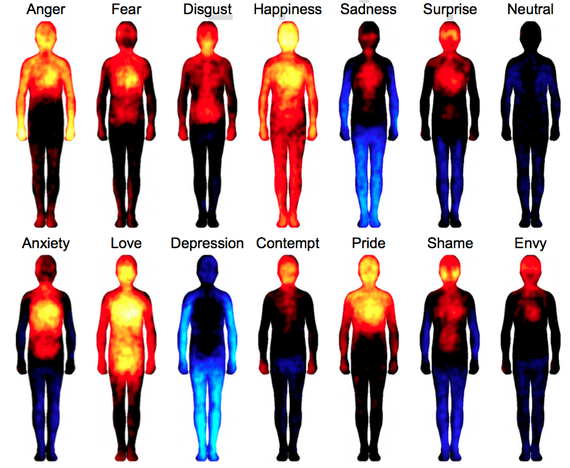
Emotions are felt in the body as sensations. Expressions such as, “cold feet, sweaty palms, goosebumps, shivers down my spine, butterflies in my stomach, weak in the knees, hot headed, cold hearted…” are commonly used to sum up emotional states. Recently, researchers from Finland created colorful images that map how the engagement of specific body areas corresponds to 14 different emotions.
The new cross-cultural study titled, “Bodily Maps of Emotions” was published December 31, 2013 in the journal Proceedings of the National Academy of Sciences. This study from Aalto University in Finland, isolated a broad spectrum of emotions and created colorful body maps that correspond to 14 different emotions. The researchers found that the most common emotions trigger strong bodily sensations, and the bodily maps of these sensations were cross-cultural.
The engagement and disengagement patterns of the emotional body maps were consistent across different West European and East Asian cultures. This suggests that emotions and their corresponding bodily sensation patterns have a universal biological topography.
“Emotions adjust not only our mental, but also our bodily states. This way they prepare us to react swiftly to the dangers, but also to the opportunities such as pleasurable social interactions present in the environment. Awareness of the corresponding bodily changes may subsequently trigger the conscious emotional sensations, such as the feeling of happiness,” said assistant professor Lauri Nummenmaa from Aalto University.
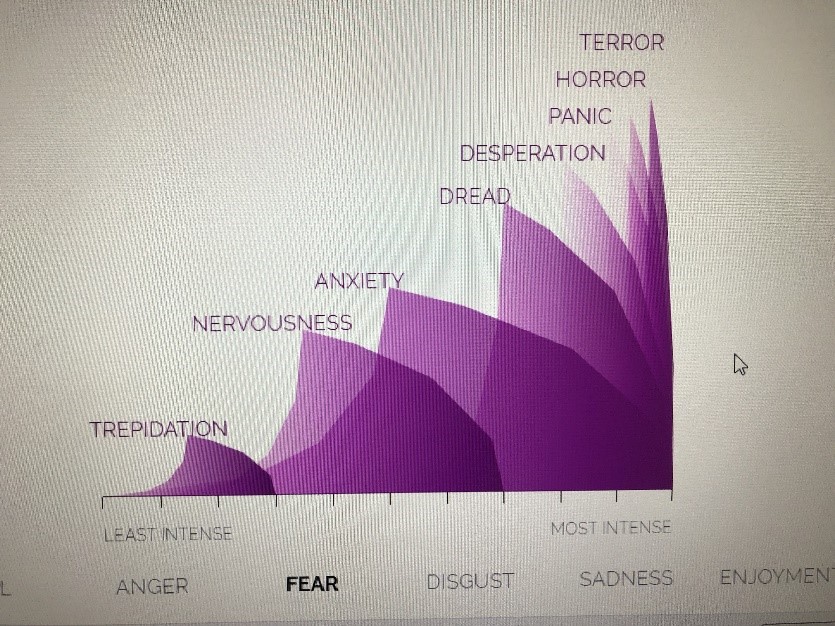
Paul Ekman’s Atlas of Emotions[iii] is a tool that I discovered on the topic of emotions. The Atlas of Emotions is a powerful interactive tool for learning to identify one’s emotions and gain an understanding of one’s emotional world. Emotions guide our perceptions of the world, our memories of the past and even our moral judgments of right and wrong, most typically, in ways that enable effective responses to the current situation. According to Ekman “Anger contains both annoyance and fury”. The intensity of these states varies: We can feel mild or strong annoyance, but we can only feel intense fury.
In the interactive Atlas of Emotions, each emotion– Anger, Fear, Disgust, Sadness, Enjoyment– is mapped in terms of intensity of feelings associated with it and its duration. Annoyance is least intense and of short duration, exasperation is more intense and lasts long, whereas vengefulness is very intense and peaks quickly. Shown below is the “atlas” of FEAR…from trepidation to terror.
The corresponding body map of FEAR and LOVE, from the Alto University study, show where fear and love are felt most intensely in the body.
“Emotions are just a form of energy, forever seeking expression.”[iv] Negative emotions of fear, disgust, sadness make the body feel heavy whereas positive emotions of love, joy and enjoyment feel light and airy.
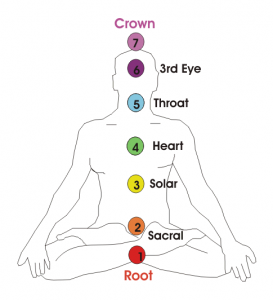
In Hinduism, going as far back as the Vedas, the human body is said to comprise of the physical body and a subtle body. The subtle body is the emotional body. The subtle body is energy and the physical body mass. The subtle body is made of channels of psychic energy called nadis and has energy nodes called chakras.
The baser emotions are said to correspond to the lower chakras, as one moves up the energy centers the associated emotions are nobler in character. Negative emotions are said to be the result of blockages in the chakras which inhibit the flow of energy through the body. The psychic energy in the body is likened to a coiled cobra, and when the chakras are open the energy flows uninhibited, the cobra is uncoiled. This is the kundalini awakening in Hinduism.[vi]
At the opposite end of esoteric beliefs is the work being done at MIT’s Computer Science and Artificial Intelligence Lab (CSAIL) on emotion detection system using Wi-Fi. CSAIL has built a system called EQ-Radio that can identify emotions using radio signals from a wireless router whether or not a person is speaking or showing their emotions with facial expressions.[vii]
Emotions are barometers of our mental state. Negative emotions draw our attention to areas in us that need to be healed. The energies trapped in our emotions are looking to be released. We can release these energies consciously or they will release themselves often causing drama in our lives. Emotions that are held back and not releases leave am emotional scar in us.
My deep dive into my emotions has been both exhilarating and unnerving. My “journey from head to heart” has been emotional (pun intended). I have learnt a lot about myself and have shed some emotional baggage. I have acquired tools for understanding what makes me be “me”. I can meditate, watch my thoughts and emotions, and I can tune into my bodily sensations. These practices have helped me release energy blockages, allowing life to flow through with less resistance. What we resist persists.
This I believe:
Negative emotions are messengers directing us to areas in our being that need healing. They are trapped energies seeking release.
There are 37.2 trillion cells in a human body[i] and 86 billion neurons in the nervous system. There are more neurons in the human brain than there are stars. It is estimated that there are 100 trillion synapses in the brain.
There are 35 billion epithelial cells in our skin, these cells are in contact with the world outside us. To the atoms in these cells there is no separation between what is inside and what is outside. At a cellular level there is no separation between us and what is outside of us. All of our 37 trillion cells are connected to the rest of the universe and are part of the great cosmic web. As we take a breath in and breathe out we pulse the universe. With each beat of the heart we create waves in the universe. George Leonard writes, in his book The Silent Pulse[ii] “at the heart of each of’ us, whatever our imperfections, there exists a silent pulse of perfect rhythm, made up of wave forms and resonances, which is absolutely individual and unique, and yet which connects us to everything thing in the universe. The act of getting in touch with this pulse can transform our personal experience and, in some way, alter the world around us.”
There is a “sacred rhythm” in our bodies, this rhythm is unique to each of us and part of the symphony of the universe. The ancient Chinese practices of Tai Chi and Indian Yoga are designed to bring one’s body and mind in harmony with this silent rhythm, and it with the rhythm of the universe.
Sri Aurobindo, an Indian mystic, wrote extensively on integral yoga[iii]– a union of mind, body and soul. Michael Murphy[iv], the founder of the renowned Esalen Institute in Big Sur, California, and George Leonard codified the teachings of Sri Aurobindo into a practice called Integral Transformative Practice (ITP). I decided to explore this practice and became a member of ITP in 2010. Through this practice, I discovered that the body has a wisdom of its own, separate from the mind. It is only when the mind and the body are in alignment that we experience peak performance and are at our best.
In his autobiography, Second Wind: The Memoirs of an Opinionated Man, Bill Russell evokes the “mystical feeling” that on occasion would lift the action on the hardwood to the level of magic:
“At that special level all sorts of odd things happened…. It was almost as if we were playing in slow motion. During those spells I could almost sense how the next play would develop and where the next shot would be taken. Even before the other team brought the ball in bounds, I could feel it so keenly that I’d want to shout to my teammates, “It’s coming there!” – except that I knew everything would change if I did. My premonitions would be consistently correct, and I always felt then that I not only knew all the Celtics by heart but also all the opposing players, and that they all knew me.” [v]
Mihaly Csikszentmihalyi studied athletes, musicians, artists and people from all walks of life for his book, “Flow: The Psychology of Optimal Experience”[vi], and he found that the state of flow occurs when the mind and body are in complete harmony. In this state time seems to stop and movement seems effortless, and the subjects report their experience as being mystical.
My body is not just a vessel or a container, it is an active participant along with my mind in creating the experience I call my life. The 35 epithelial cells that constitute my skin are sensors that gather information from the outside and transmit it to my brain, which processes it to create my reality. Conversely my cells tune-in to my mental states and convert them into bodily sensations. These sensations carry information about my mental state. This is what is meant by body language. Our bodies telegraph our mental state. When we smile the world smiles at us.
The epithelial cells are two-way sensors that link to and communicate with the worlds inside and outside us. Our body is both a transmitter and a receiver, it broadcasts our mental states to the world outside and it receives signals from the outside which it transmits to our brains. We are constantly receiving and sending signals through our bodies. We are in non-verbal communication with our mind and the world outside through our body.
Our bodily sensations are unfiltered messages from our unconscious giving us an accurate read of our mental state. For example, when we are happy our body feels light and airy, when we are sad it feels heavy and burdened. We feel our emotions in our body. We often hold our emotions for long periods of time, hence the expression “bottle up our feelings”. Our feelings want release, when we hold them back, the tension builds up in our body and either becomes a scar tissue in our psyche or releases itself as an outburst at some importune moment.
I have learnt from my dog to release my emotions as they occur, I shake them off. Have you noticed how dogs shake off their emotions and carry on as if nothing happened?
I have learnt to listen to my body and tune-in to my bodily sensations. I have discovered that “quieting” my body is as important as quieting my mind for achieving flow state.
This I believe:
My bodily sensations are unfiltered messages from my unconscious. There is wisdom in my body beyond that which is in my mind.
Meditation is about quieting one’s mind. A mind without thought is not a thoughtless mind. It is an empty mind, a mind with nothing in it. It is a no mind, as Buddhists say. Sunyata[i] or emptiness in Mahayana Buddhism is enlightenment.
By this point in my journey, I was deeply immersed in two fields of inquiry–physics and the Vedas. These fields were converging for me. Wisdom of the Vedas was shining new light on many abstract concepts in modern physics, such as wave-particle duality. Conversely recent theories in physics, such as the nature of the void, were giving me, a scientist, permission to be open to the insights of the Vedas.
I was beginning to accept that the Vedic sages were scientists, of sorts, and they used, what Einstein called, “thought experiments” to arrive at their deep insights. They had other highly developed “tools” for probing into reality, such as meditation, yoga and mantras. I was no longer skeptical of these eastern practices and was ready to explore them for myself. I took up meditation.
Don’t let anyone tell you that meditation is easy. My father-in-law would tell me “all that you have to do is watch your thoughts”. As hard as I tried, I could not quieten my mind. I later learnt that trying hard is the problem. One has to just let go. I was ready to give up on meditation. In desperation, I took to extreme measures to quieten my mind.
I started by listening to music while wearing high fidelity headphones and cranking up the volume. I mostly listened to drums and Buddhist chants. Low frequency sounds would drown out the noise in my head. Lo and behold, my mind would quieten. I would drop into a state of “no mind”, lost in my music. The longer the music went the better I felt.
I was so drawn to this experience that it became my practice for almost a year. Every night I would put my headphones on and repeat the exercise. I became addicted to the experience. This was also the time that my teenage son started a punk band. I took to going to his performances and losing myself in his music. I would close my eyes and listen to his very loud band with my entire body, this experience too, as strange as it sounds, would quieten my mind. This was my introduction to meditation. Very unorthodox, I admit.
After years of listening to loud music through headphones and going to concerts with a view to “meditating” in this unorthodox way, I felt motivated to try traditional meditation. I was now able to let go of the chattering monkey in my head and sit quietly in meditation. I was able to watch my thoughts float by, like wisps of clouds in the sky. Often my mind would become still and completely quiet. In those moments I experienced nothingness of the void. It felt good.
I meditate often, and I can drop into meditation in the noisiest of places, such as in crowds or at a party. The switch for me from an outward focused life to a life lived inside-out started when I became skilled at watching my thoughts and meditating. I flipped from being a scientist of the world outside-a physicist, to a yogi of the mind. I could now switch easily and seamlessly between two realities-the external reality and the internal reality. I had the know-how to experience first-hand what the ancient sages spoke of. The wisdom of the ancient sages was now a realized experience for me, it was no longer an abstract idea. I could replicate the experience of the sages. Thus, I came to believe in the Vedas as much as I believed in physics. This was a breakthrough for me.
I could now integrate and synthesize two streams of knowledge-scientific and Vedic. I look at scientific knowledge as the “wisdom of the west” and the Vedas as the wisdom of the east. I have understood that they both point to true north or the absolute truth.
The absolute truth, soul, spirit, God or Reality by any name is within us. The journey in search of Reality is like traveling down the yellow brick road, in the Wizard of Oz, the further you go the more you come to know yourself,[ii] as Dorothy, the Scarecrow, the Lion and the Tinman did.
This I believe: 10. Self-discovery is a slow unfolding. The further you go on this journey the more you come to know yourself.
It seems we cannot rely on our senses to reveal what is real and what is a figment of our imagination. Perhaps poetry, music, and dance are better guides to reality than our intellect. Reality does not speak to us as much as it touches us. We do not see Reality, but we feel it.
“To see a World in a Grain of Sand
And a Heaven in a Wild Flower,
Hold Infinity in the palm of your hand
And Eternity in an hour.”
William Blake
William Blake’s beautiful poem speaks to me in ways that science never could. His words go straight to the core of my being, bypassing flesh, bones, and the intellect. Nothing in science, except, perhaps, pure mathematics, moves me so. “To see a world in a grain of sand….” are just words strung together, and, in a literal sense, the sentence is meaningless and a physical impossibility. Yet, the sentence transcends my senses and intellect and touches me deeply. What it touches inside of me feels as real to me as anything outside of me. In this case, the words of William Blake evoke feelings that are deeper, richer, and more pleasant than the physical world brought to me by my senses. What is inside of me feels more real than the outside. I am convinced that there is a presence inside of me that I should get to know.
Reading Rumi, listening to classical music, dancing like a Sufi, or seeing Escher sketches transports me to a different place. A reality that is beyond the reach of my five senses and intellect. In this verse, Rumi, it appears, is speaking to me: “…. like a scientist, you collect data and put facts together to come to some conclusion. Mystics arrive at what they know differently; they lie on a person’s chest and drift into the answer. Thinking gives off smoke to prove that there is a fire. Mystic sits inside the burning.” (The Soul of Rumi, 2002).
I feel like the scientist in Rumi’s poem, who, after collecting data from science and the scriptures, concluded that reality is more than our senses can perceive. I know what it is not, but I am ignorant of what it is. I want to be the mystic. I want to “sit inside the burning.” I am longing to know.
I was looking for reality in all the wrong places. Physicists are in search of reality “out there.” On the other hand, the Vedic sages believed that there is only one way to know Reality: to know oneself. Reality lies within, the sages say, and the mystics “sit inside the burning”- they live this truth. Many renunciates claim to be “with God” all the time. Can ordinary people like me “live in the world and not be of it”?
J.Krishnamurti, a noted Indian philosopher, writes, “… you can understand what you are, only by watching yourself, not trying to correct it, not trying to shape it, not trying to say this is right, this is wrong, but seeing what is actually taking place.” 30 Krishnamurti called this practice of watching one’s thoughts, moment to moment, Choiceless Awareness. To know oneself is to know the contents of one’s mind’s desires, fears, beliefs, hurts, and everything else.
Choiceless Awareness is a process by which one withdraws from the world outside and turns the focus inward–on the self. Most people go through life unaware that their inner life is worth examining. They go through life not knowing who they really are. “Who are you?” asked the Caterpillar of Alice in Alice’s Adventures in Wonderland, “I can’t explain myself, sir,” said Alice, “because I am not myself, you see.”
I was fortunate to have been introduced to the practice of Choiceless Awareness by my father-in-law. I taught myself to watch my thoughts, emotions, and bodily sensations. I applied scientific tools of observation and data-gathering to myself. I recorded my thoughts as they surfaced and watched them without judging them and with complete detachment. I can watch a thought arise, and if I do not engage with it, it floats away; another thought appears, then another. After a while, the thoughts stop, and the mind becomes quiet. In these moments, I am lost to the world. These moments are like deep sleep, except that I am awake. J. Krishnamurti, in his book “The First and Last Freedom”[i] writes that the path to freedom from suffering is self-discovery. According to the Upanishads, self-knowledge is the ultimate goal of life.
My father-in-law advised me that the “only thing that you have to do is to watch your thoughts.” There is no need for a guru or a guide; one becomes one’s own guru just by watching one’s thoughts. By watching one’s thoughts, one gets to know the contents of one’s mind and realizes that we are not the contents of our minds; we get to know who we really are. “Know thyself” is an ancient Greek aphorism inscribed in the Temple of Apollo at Delphi.
“Who am I?” I am not my body. I am not my thoughts. I am not my fears. I am not my desires. So, who am I?
Nature is proof that She is a mathematician. It is as if math is Her preferred language for revealing Her deepest secrets to us. F=ma, Newton’s Laws of motion gave us the mechanical age and , Einstein’s mass and energy equivalence gave us the atomic age. Through these equations She gave man the power to harness her energy for his purposes. Physicist and futurist Michio Kaku believes that one day physicists will find an equation about “six inches long” that will explain all of nature. A single super equation, that would explain all of nature, from the behavior of subatomic particles to black holes and galaxies. A hope and a dream to be sure, but as Einstein said we want to know “the mind of God”.
We are familiar with equations in physics and in the sciences, but what about describing a beautiful flower, a fern, a sea shell or a perfect wave in the ocean? Does She reveal her creative nature through math too?
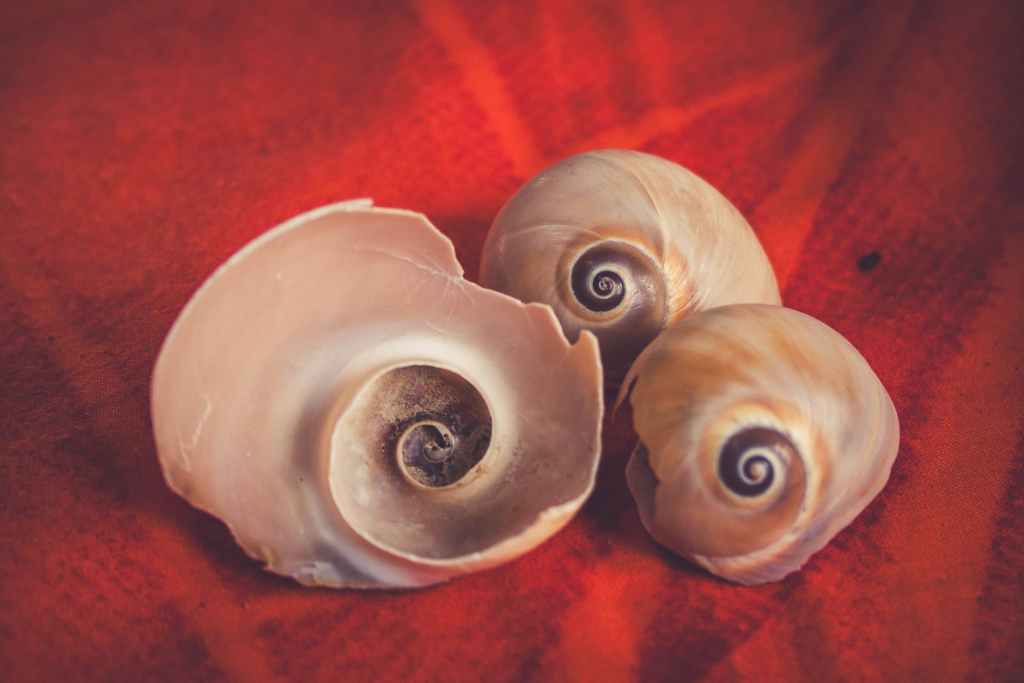
Zn +1 = Zn 2 + C is the mathematical equation describing the Mandelbrot Set, named after the discoverer Benoit Mandelbrot, a Polish born, French, American polymath. The Mandelbrot Set are fractals which describe amazing shapes occurring in nature. “Fractals are special mathematical sets of numbers that display similarity through the full range of scale — i.e., they look the same no matter how big or how small they are. Another characteristic of fractals is that they exhibit great complexity driven by simplicity”.[i] Fractals are self-similar patterns of complexity driven by simplicity. The smallest unit of a fractal is similar to the whole. Fractals appear in nature in sea shells, galaxies, ferns and even human lungs.
Photo by Di Lewis on Pexels.com
“The mathematical beauty of fractals is that infinite complexity is formed from relatively simple equations. By iterating or repeating the fractal-generating equations many times, random outputs create patterns that are unique yet recognizable.” (Mcnally, n.d.).
What amazes me about fractals is that they are so prevalent in nature, are beautiful and yet complex patterns that can be represented by simple formulae.
Is math an expression of nature or vice versa?
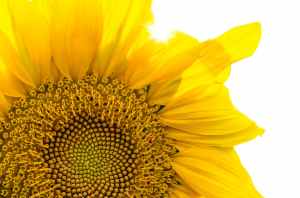
Xn = Xn-1 + Xn-2 a sequence of numbers known as Fibonacci sequence was invented by Leonardo Pisano, an Italian mathematician, who was also known as Fibonacci (son of Bonacci). The sequence of numbers written out are 1, 1, 2, 3, 5, 8, 13, 21, 34, 55…these numbers appear mysteriously in nature over and over again. This is why it is often referred to as nature’s secret code. This hidden code can be found in the numbers of petals on a flower, the structure of fruits and vegetables, the proportions of the human body, and even in the unique shape of spirals in nature. “Sunflowers are particularly fascinating as they show Fibonacci numbers in so many ways. Count the petals on a sunflower–there are many! –and you’ll most likely count exactly 21, 34 or 55 petals–nothing in between. If you look closely at the center of a sunflower, you will see a spiral pattern. In fact, there are spirals in two directions. If you have the patience to count the number of spirals, it will always be a Fibonacci number. Count the spirals in the other direction and it will be an adjacent Fibonacci number. So, if you count 34 spirals going to the right, you know that there will be either 21 or 55 spirals to the left.” Source: Fibonacci in Nature.[ii]
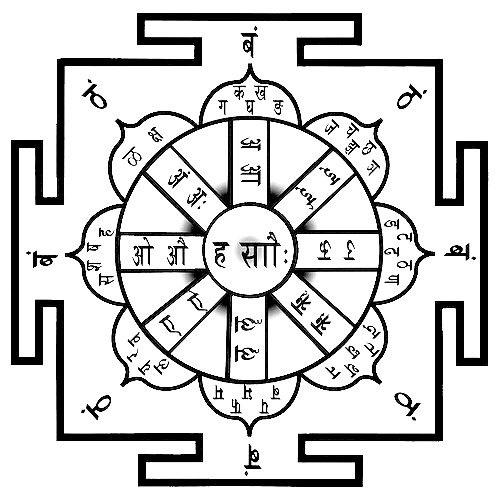
Long before Tegmark, Mandelbrot and Fibonacci there was Pythagoras, circa 400 BCE, who believed in divine geometry and started a religious movement based on this belief. Predating Pythagoras are mandalas–geometric patterns representing the universe– which first appeared in the Vedic text Rigveda. Mandalas are symbolic representations of the entire universe. The Vedic sages did not have knowledge of mathematics but they intuited (or divined) that the physical universe was a symbolic representation of the “mind of God”. Mandalas, like equations in physics, reveal the hidden order in the universe.
The Vedic sages believed that behind the forms in nature are deep patterns, and these patterns contain the inherent harmony in nature. Mandalas are representations of this harmony. The act of drawing mandalas and meditating on it, brings man and nature in harmony.
Physicists and the ancient Vedic sages have come to the same conclusion that behind forms and appearances are patterns, which can only be expressed in the abstractions of math and geometry.
Paraphrasing Maria Popova, who wrote in her essay[iii] on Susanne Langer that great art, requires a dual contemplation– “it asks the artist to contemplate her interior life and give shape to what she finds there in abstract form; it asks the audience to contemplate the abstraction and glean from it transcendent resonance with our own interior life.” Mandalas are sacred geometry that are “an act of translation–inner to outer to inner….in the act of that two-way translation, (they) transform us”
The point of abstractions to represent Reality is that the world we live in might be abstract, not material. Reality, therefore, is best represented by abstractions, like the mandalas or mathematical equations. Symbols are abstractions, it is we who give them meaning, as in Rorschach tests. Therefore, it is meaningless to ask what the meaning of life is because it is we who give life meaning.
The mind of God is revealed through math and the mind of man projects meaning onto it. God is a mathematician. And, Life is a Rorschach test[iv]!
Mathematics is abstract, symbolic, structured and precise. It is true everywhere and always and mathematical laws cannot be violated, ever. Math sounds a lot like the attributes of God-eternal, omnipresent and omnipotent. According to theoretical physicist Michio Kaku “”The mind of God we believe is cosmic music, the music of strings resonating through 11-dimensional hyperspace. That is the mind of God.”[i] Vern Poythress, who teaches New Testament in Cambridge University and has two doctorates, a PhD in mathematics from Harvard and a doctorate in Divinity, argues in his book Redeeming Mathematics: A God Centered Approach[ii], that “the harmony of abstract mathematics, the physical world of things and our thinking depends on the existence of Christian God.” Srinivas Ramanujan, on whose life the book and the movie “The Man who knew Infinity”[iii] are based is known to have said that “an equation to me has no meaning unless it represents a thought of God”.
The structures of the universe, from the tiniest (subatomic size) to the largest (cosmic scale), can be visualized as networks or webs of connections. And, these networks are interlocking, pulsating particles, exchanging, sharing and transforming energy from one form to another. Physics today is understood through mathematics. Scientists have long used mathematics to describe the physical properties of the universe. But physicist Max Tegmark[iv] goes even further and believes that the universe itself is math. In Tegmark’s view, everything in the universe — humans included — is part of a mathematical structure. All matter is made up of particles, which have properties such as charge and spin, but these properties are purely mathematical, he says. And space itself has properties such as dimensions but is still ultimately a mathematical structure.
Mathematics, numbers, symbols, information and energy are different ways by which physicists have attempted to describe the universe. Modern theories in physics are abstract and mystifying to most. For many, faith in the divine origin of the universe provides more certitude than modern physics does. Faith gives one certainty which physics is unable to do, this is the appeal of faith for many. Certainty in an uncertain world is comforting.
Scientific knowledge has an asymptotic relationship to truth or Truth. Scientists are getting closer to the Truth but, I suspect, will never reach it. Scientists are like Adam reaching out to touch the hand of God but not making it, as depicted in the fresco[v] on the ceiling of the Sistine Chapel.
Physicists are peering into the outer reaches of the cosmos and probing deep into the inner sanctum of atoms, discovering realms that are beyond the reach of our senses. For most of us, these realms are difficult to comprehend, because we cannot see, touch or feel them. No one has seen a quark or been able to visualize Einstein’s four-dimensional space and time. Hence, to some, modern physics is incomprehensible, abstract, hard to relate to, and indistinguishable from a myth.
Thankfully, we do not rely just on our senses to understand the universe, if we did, we would still be in the dark ages.
Physicists are looking for a single theory, or as Michio Koku states “an equation about six inches long”, which can explain all phenomenon, from the largest (cosmos) to the tiniest (subatomic particles). The holy grail in physics is to find a theory that reconciles general relativity and quantum physics. Science is in search of ultimate unity, the God Particle[vi], as Nobel Laureate Leon Lederman wrote in his book of the same name. Particle physicists keep building bigger and bigger particle accelerators, like the one at CERN[vii], in search of the God particle. At CERN, in the Large Hadron Collider, energy at the point of collision of the protons approaches the energy moments after the Big Bang, in the hope of finding the God particle.
The truth is that the Truth might not be a particle. Truth might not be a thing, it might be an abstraction, like an “idea in the mind of God”, as some have suggested or perhaps as Max Tegmark posits “There’s something very mathematical about our Universe, and that the more carefully we look, the more math we seem to find. ….. So, the bottom line is that if you believe in an external reality independent of humans, then you must also believe that our physical reality is a mathematical structure. Everything in our world is purely mathematical – including you.”
Theologists, scientists and philosophers seem to agree that Reality, absolute truth or God, if you will, is an abstract reality. Not a reality that can be detected by our senses or known through our intellect. In this view mathematics are an expression of the mind of God. She is a mathematician!
Further proof is in sacred geometries found in nature.




 Shiva's Dance