Unknown's avatar

Posts by smehro

work in progress

God is a Gamer.

Our Universe is a Virtual Reality Game.

Let’s look at Creation from God’s perspective, not ours. Why did God create this Universe? The Vedic sages, in my opinion, have the best explanation for why. According to the Vedas, God created the Universe for its sheer joy. God wanted to have some fun.

The Vedic sages were deep thinkers, and their insight was that all Creation is Sat. Chit. Ananda—Existence. Consciousness. Joy. Sat is the objective universe-the world of matter, energy, and forces, the world that physicists study. Chit is consciousness. Consciousness is the creative energy that animates Sat. Ananda is the joy of experiencing Creation. Sat. Chit. Ananda is all there is.

Of course, this is speculation, but neither science nor religion will ever know why the Universe exists. So, let’s play with the idea that there is a God, and he(she) created the Universe for the joy of it. We humans exist because God has a sense of humor. We are here for the amusement of God; this may sound esoteric or far out, using a sixties expression. What if this is true?

Let’s put God in our digital age and imagine she is a gamer. She designs virtual reality games for the fun of it. Her most incredible virtual reality creation is Creation. The humans (us) are her user interface or haptic devices for her to interact with her virtual reality game. The only way she can have a sensory experience of her creation or Creation is through humans. Let me explain this again. Just as virtual reality designers here on earth create virtual reality goggles and gloves to interact with their virtual worlds, God created humans to be her interface.

Now it all fits. God created this virtual reality game that we consider our Universe, and she made us her user interface. She did this for her amusement. Sat. Chit. Ananda.

We humans take ourselves too seriously. We are just a user interface for God. Religions have been telling us this but in an archaic language “thy will be done on earth as in heaven,” meaning let God work through us her user interface, do not resist, surrender to the will of God.

I will submit that if you re-read the holy texts, be it the Bible, Vedas, Buddhists texts, or Quaran, from the perspective of God as a creator of this virtual reality game we call our Universe; you might be amazed at how the teachings make sense. All religions teach us how God wants us to be. Do they not?

Meditation Is Hard.

An unorthodox approach to meditating.

Don’t let anyone tell you that meditation is easy. “All you have to do is watch your thoughts, and your mind will become quiet,” Jiddu Krishnamurty called it Choiceless Awareness. As hard as I tried, I could not quieten my mind. I was ready to give up on meditation.

Out of desperation, I took to extreme measures to quieten my mind. I started by listening to music while wearing high-fidelity headphones and cranking up the volume. Low-frequency rhythmic sounds would drown out the noise in my head. I mainly listened to drums and chants and would drop into a state of “no mind”; lost in my music. The rhythmic sound of drums and the Gregorian and Buddhist chants would stop the chattering in my mind. The longer the music went, the better I felt.

I was so drawn to this experience that it became my practice for almost a year. Every night I would put my headphones on and repeat the exercise. I became addicted to the experience. My teenage son was in a punk band during this period in my life, and I took to going to his performances and losing myself in his music. I would close my eyes and listen to his loud band. This experience, too, as strange as it sounds, would quieten my mind.

After a year of listening to loud music through headphones and going to concerts with a view to “meditating” in this unorthodox way, I felt motivated to try traditional meditation. After quieting my mind through music, I would stop the music and sit quietly in meditation. I could watch my thoughts float like wisps of clouds in the sky. Often my mind would become still and completely quiet; in these moments, I was lost to the outside world, lost in the void. It felt good.

I meditate often. I drop into meditation in the noisiest of places, such as in crowds or at a party. I became skilled at Choiceless Awareness. I can watch my thoughts. I have flipped from being a scientist to a yogi of the mind. I can now switch quickly and seamlessly between two realities-the external reality and the internal reality. It is almost as if I have a quantum brain or a dual way of being. I can connect with the world of my senses or transcend my senses and enter a different reality.

No mind, no matter. No matter no mind

There is a tale about an Indian king that my father-in-law is fond of telling. The story goes that one night the king dreamt that he was a pauper; he woke up very disturbed because now he did not know whether he was a pauper dreaming that he was a king or a king who had dreamt that he was a pauper. We are like the king; how do we know we are not in a dream?

Even science can’t tell me if I am dreaming or awake at this moment. As I write this sentence, I could be dreaming that I am writing this sentence. The brain processes are the same when I am dreaming as when I am awake. The firing of neurons in our brains is how we see, feel or sense anything. Our senses bring information from the outside world to our brains through our neural systems. The trees we see, the birds in the sky, and other people, are all created in our brains. Every object outside us has a unique pattern of neuron firings. Each blade of grass, each cloud in the sky, everything has a unique pattern of neural firings in our brains. All that we perceive- the world outside us, our thoughts, feelings, and bodily sensations- are patterns in our brains. Our dreams are also made of patterns of neurons firing in the brain. How our dreams are made is no different from how reality is constructed in our brains. We create the world in our minds. Our world is a projection of our mind. It is all in our heads. What is inside is outside.

Our body, too, is a pattern of neuronal firings. I perceive my body as a pattern of firings in my brain. This does not mean that my body does not exist; all I can be sure of is that something exists. This “something” creates a pattern of neuronal firings, which my brain makes me believe is my body. For all I know, I might be a hat rack. Oliver Sacks’ book “The Man Who Mistook His Wife for a hat”[i] is about a brain impairment called visual agnosia, wherein a person is unable to recognize objects. Sacks writes in his book about a man with visual agnosia who mistook his wife for a hat. The point is that our brain creates an image we recognize as our body. When the brain circuitry is impaired, as in the case of patients with visual agnosia, the image created to represent the body could be anything. Those afflicted with anorexia have a distorted image of their body, making them think that they are overweight when they are underweight. These examples illustrate what shaky ground we are on when we accept, uncritically, as real what our senses tell us.  

 “…few things about our beings are as remarkable, foundational, and seemingly mysterious as consciousness. Without consciousness- a mind endowed with subjectivity- you would have no way of knowing that you exist, let alone know who you are or what you think. “Antonio Damasio,[ii] professor of neuroscience at the University of Southern California, and the head of the Brain and Creativity Institute, in his book “Self Comes to Mind,” writes.

According to Damasio, our brain creates our conscious mind. Our conscious mind creates our reality. He continues, “The fact that no one sees the mind of others, conscious or not, is especially mysterious. We can see their bodies and actions, what they do or say or write, and make informed guesses about their thoughts. We cannot observe their minds, and only we can observe ours, from the inside and through a rather narrow window.”

Damasio offers a neuroscientist’s view of how our mind creates our reality. Damasio is saying that the contents of our mind create our reality. If we change the contents of our minds, we change our reality. Let this sink in. Each one of us exists in our reality. And, each of our realty is mind created. It is as if each of our lives is in our bubble or a simulated reality of our creation.

Elon Musk, founder and CEO of Tesla and SpaceX, believes that the odds are that we are living in a simulation. His argument goes that the swift advancement of video game technology indicates we’ll be capable of creating a fully lifelike simulation of existence in a short period. In 40 years, Musk explained, we’ve gone from Pong to massively multiplayer online games with millions of simultaneous players, games with photorealistic graphics, and stand now on the cusp of a new wave of virtual and augmented reality experiences.

Neil deGrasse Tyson, director of the museum’s Hayden Planetarium, put the odds at 50-50 that our entire existence is a program on someone else’s hard drive. “I think the likelihood may be very high,” he said. Somewhere out there could be a being whose intelligence is that much greater than our own. “We would be drooling, blithering idiots in their presence,” he said. “If that’s the case, it is easy for me to imagine that everything in our lives is just a creation of some other entity for their entertainment.”

We each inhabit a different reality, a reality of our creation. Therefore, the truth that each of us perceives is relative. So, what is absolute Reality?

No matter, no mind. No mind, no matter. Which came first, mind or matter? This is the existential question.


[i] (https://www.oliversacks.com/books-by-oliver-sacks/man-mistook-wife-hat/, n.d.)

[ii] (Damasio, 2010)

Nothing Matters

If life is Maya, an illusion, as the Vedas say, or that there is more to reality than meets the eye, as scientists have proven, then what is real?

The Cheshire cat, in Alice in Wonderland, is the wise one, always ready with an answer to Alice’s questions. It appears and disappears at will. Sometimes the cat is gone, and left behind is its smile. Reality might be like the smile on the Cheshire cat. The smile is real, the cat illusory. What we don’t perceive might be more real than what we do.

When I look out of my window, I see trees with branches and leaves. The tree is separated from other trees by empty spaces, the branches are separated from other branches by spaces between them, and the leaves too are separated from other leaves by spaces between them. Without the spaces, the tree would be a big mush. Without space, there would be no objects. When we remove objects, all that is left are spaces in between, like the smile on the Cheshire cat. Does space give rise to objects? Can there be one without the other? Is the nothing of space something? 

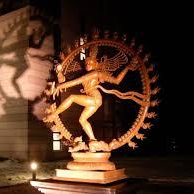
The new frontier in physics is the “nothingness” of space. Physicists are trying to figure out what it is. Nothing apparently is not no-thing. At first, physicists believed that space was filled with the mysterious substance ether. This idea was experimentally put to rest by Michelson and Morley in 1887[1].  More recently, physicist John Wheeler commenting on Einstein’s theory had this to say about the nothingness of space “Mass tells spacetime how to curve, and spacetime tells mass how to move.” This put nothingness of space on the same footing as matter. “Nothing” mattered from this point on. Space was no longer an inert stage on which matter did its thing. Nothing is active in the cosmic dance, moving and being moved by matter. The nothingness of space is not emptiness but is as much a player (or should I say a dancer) as objects are in Shiva’s cosmic dance.

“Plato, who so vigorously avoided the void…. sounding a little bit like a chemist, seemed to view the background (void) something like a neutral solvent–something that allows other things to come to be without imposing too much of its personality. The background can’t have any personality of itself, otherwise, it would be showing its own face as well.” Wrote K.C. Cole, The Hole in the Universe.

Philosophers such as Plato and today’s scientists agree that the void of space, the nothingness, has no detectable features. So, what is this void? And how do we find out what it is?

“…suffice it to say that very little in the universe is nothing. Almost all the seeming nothings are sums of opposing somethings,” writes K.C. Cole. “What seems like a silent sea of nothing is an infinite number of positives and negatives, all joining together and splitting up in an endless jumble of uncertainty.”

Nothing is not no-thing, but, instead, is teeming with potential some things. It is full of matter and antimatter in equal proportion, canceling each other, which the scientists refer to as conserved quantities or the law of conservation. The things that are conserved are energy, momentum, and charge. The most fundamental things in nature are those that never change. These are changeless and timeless. As is the speed of light, it is a constant, no matter what. It is interesting to think that a photon that travels at the speed of light never ages. The photon that started at Big Bang is still the same photon. It is timeless.

Symmetry is a term used by physicists to describe the void or emptiness of space. It is what accounts for the void or nothingness but has no detectable features. Symmetry is the reason why the void appears as nothing, yet it is full of potential energy and teeming with matter and antimatter. Symmetry is what cancels matter and its opposite, resulting in nothing or the void. Symmetry is an important concept in physics. All the conservation laws are the result of symmetries in nature. Conservation laws are the accountants of nature; they balance the books, that is, they make sure that energy is never created or destroyed, and all the energy that we started at Big Bang is conserved. In other words, when we reassemble all the fragments of nature that happened during the Big Bang, we return to nothing.

Symmetry is the equivalent of Yin and Yang in Zen Buddhism. Yin and Yang’s symbol represents opposites that exist in harmony as one until that harmony is broken, and then they become opposites.

Another analogy for Symmetry is if you were to walk into a glass door thinking there was nothing there, and you shatter the glass into many pieces, you have just broken Symmetry and created something out of nothing.

When symmetry is broken, something emerges. Out of nothing comes something. In the beginning, there was nothing, just the void, which was teeming with potential something. By breaking this symmetry, our universe emerged at Big Bang. This is the creationism story in science.

The creationism story in the Vedas is written in hymn form in the Rig Veda. It too, speaks of how in the void, the opposite existed until “symmetry” was broken, and creation happened.

First, there was the void:

    Then there was neither death nor immortality

    , nor was there then the torch of night and day.

    The One breathed windlessly and self-sustaining.

    There was that One then, and there was no other.

In the void existed opposites:

The sages who have searched their hearts with wisdom

know that

which is 

kin to that which is not.

Rig Veda, Creation Hymn 1500 BCE —Translated by A. L. Basham

It seems that all of existence is the dance of opposites. When the opposites merge, as in Yin and Yang or in the concept of Symmetry, there is a void. The void is seemingly nothing but in it is the potential for everything.

From the void emerged the “opposites”-matter and anti-matter, spaces and objects, darkness and light. Without opposites, there is no existence. Without darkness, there is no light; without evil, there is no good. We know a thing by its opposite. Reality itself is non-dual[ii]; it is an undivided whole. Because of the limitation of our sense organs, we do not see the oneness behind appearances.

Most of us accept, uncritically, what our senses tell us is reality. We are like fish in a pond; all they know is water. To them, their reality is the pond; they have no reason to suspect that there is anything other than the pond. Most of us are like that, but the few, like the physicists and the ancient sages, who have gone beyond the limitations of their sensory perceptions, have brought us tales of what lies beyond. It is up to us whether we accept what our senses tell us is reality or find out for ourselves what lies beyond the reach of our senses.

“If you look at zero, you see nothing, but look through it, and you will see the world.”[iii] Robert Kaplan.

There is a void in each of us. It is the hole we feel in our being; it is what makes us feel that there is something missing from our life. This void is the source of energy that animates us. As Rumi, perhaps the greatest poet of all time, wrote:


[1] (https://www.aps.org/programs/outreach/history/historicsites/michelson-morley.cfm, n.d.)

[ii] (https://www.youtube.com/watch?v=BZ0YFoUcY0s, n.d.)

[iii] (Kaplan, 1999)
Sacred Geometry and the mind of God

Nature is proof that She is a mathematician. It is as if math is Her preferred language for revealing Her deepest secrets. F=ma, Newton’s Second Law of motion, gave us the mechanical age and, Einstein’s mass and energy equivalence, gave us the atomic age. Through these equations, She gave man the power to harness her energy for his purposes. Physicist and futurist Michio Kaku believes that one day physicists will find an equation about “six inches long” that will explain all of nature. A single super equation would explain all of nature, from the behavior of subatomic particles to black holes and galaxies. To be sure, a hope and a dream, but as Einstein said, we want to know “the mind of God.”

We are familiar with equations in physics and the sciences, but what about describing a beautiful flower, a fern, a sea shell, or a perfect wave in the ocean? Does She reveal her creative nature through math too?
 Zn +1 = Zn 2 + C is the mathematical equation describing the Mandelbrot Set, named after the discoverer Benoit Mandelbrot, a Polish-born, French, American polymath. Mandelbrot coined the term fractals; he showed that “rough edges,” “mess,” and chaos found in nature, such as in clouds, shorelines, and seashells, have hidden order behind the chaos. He “invented the math” behind this chaos. The Mandelbrot Set is a fractal that describes amazing shapes occurring in nature. “Fractals are special mathematical sets of numbers that display similarity through the full range of scale — i.e., they look the same no matter how big or small. Another characteristic of fractals is that they exhibit great complexity driven by simplicity”.[i] Fractals are self-similar patterns of complexity driven by simplicity. The smallest unit of a fractal is similar to the whole. Fractals appear in nature in sea shells, galaxies, ferns, and even human lungs.

“The mathematical beauty of fractals is that infinite complexity is formed from relatively simple equations. Random outputs create patterns that are unique yet recognizable by iterating or repeating the fractal-generating equations many times.” (Mcnally, n.d.).

What amazes me about fractals is that they are so prevalent in nature. Not many consider this equation Zn +1 = Zn 2 + C beautiful, yet what it represents is beautiful. It makes me wonder if there is a hidden order in the universe that we have yet to uncover. Michio Kaku might be right that someday, we might find an equation that explains all of existence. We might know the mind of God. Until then, we keep discovering tiny pieces of Her creativity through math.


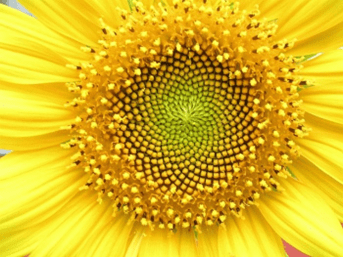
Xn = Xn-1 + Xn-2, a sequence of numbers known as the Fibonacci sequence, was invented by Leonardo Pisano, an Italian mathematician who was also known as Fibonacci (son of Bonacci). The sequence of numbers written out are 1, 1, 2, 3, 5, 8, 13, 21, 34, 55…these numbers appear mysteriously in nature repeatedly. This is why it is often referred to as nature’s secret code. This hidden code can be found in the number of petals on a flower, the structure of fruits and vegetables, the proportions of the human body, and even in the unique shape of spirals in nature. “Sunflowers are particularly fascinating as they show Fibonacci numbers in so many ways.  Count the petals on a sunflower–there are many! –and you’ll most likely count exactly 21, 34 or 55 petals–nothing in between. If you look closely at the center of a sunflower, you will see a spiral pattern. In fact, there are spirals in two directions. If you have the patience to count the number of spirals, it will always be a Fibonacci number. Count the spirals in the other direction and it will be an adjacent Fibonacci number. So, if you count 34 spirals going to the right, you know that there will be either 21 or 55 spirals to the left.” Source: Fibonacci in Nature.[ii]                                                (https://plantsandbeyond.com/2018/01/08/fibonacci-sequence-in-nature-and-plants/, n.d.)

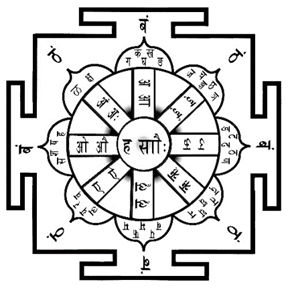
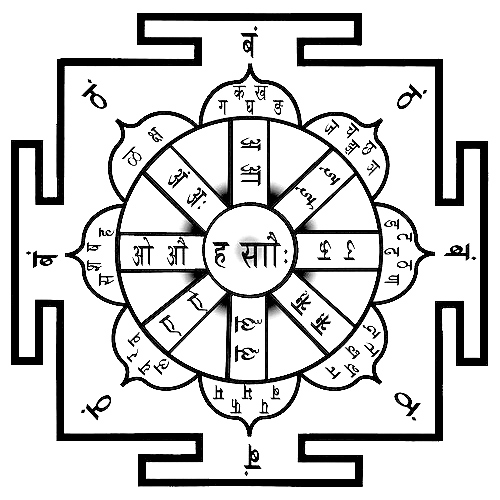
Long before Tegmark, Mandelbrot and Fibonacci, there was Pythagoras, circa 400 BCE, who believed in divine geometry and started a religious movement based on this belief. Predating Pythagoras are mandalas–geometric patterns representing the universe– which first appeared in the Vedic text Rigveda. Mandalas are symbolic representations of the entire universe. The Vedic sages did not have knowledge of mathematics, but they intuited (or divined) that the physical universe was a symbolic representation of the “mind of God.” Mandalas, like physics equations, represent and reveal the hidden order in the universe.

Source: By Шантира Шани – Own work, CC BY-SA 3.0, https://commons.wikimedia.org/w/index.php?curid=16480878

The Vedic sages believed that behind the forms in nature are deep patterns, and these patterns contain the inherent harmony in nature. Mandalas are representations of this harmony. The act of drawing mandalas and meditating on it brings man and nature into harmony.

Physicists and the ancient Vedic sages have come to the same conclusion that behind forms and appearances are patterns; these patterns have a “pattern” or rules made explicit through mathematics and geometry.

Mandalas, music, and mathematics are abstractions that transcend normal language and speak to us in ways that words cannot. Symbols make the unconscious conscious, in the words of Carl Jung. Symbols excite patterns of neuronal firings in our brain that normal spoken language does not. These patterns evoke feelings in us that no language can. The feelings they evoke have an “other-worldly” quality, which some regard as a spiritual experience. The mind of God is revealed through symbols, and the mind of man projects meaning onto them.

Paraphrasing Maria Popova, who wrote in her essay[iii]on Susanne Langer that great art requires a dual contemplation– “it asks the artist to contemplate her interior life and give shape to what she finds there in abstract form; it asks the audience to contemplate the abstraction and glean from it transcendent resonance with our own interior life.” Mandalas are sacred geometry that is “an act of translation–inner to outer to inner….in the act of that two-way translation, (they) transform us.”

What Susanne Langer wrote about great art is also true of mathematics. Mathematicians and physicists express what they find in their minds through the precise language of mathematics. Physicists reveal to us how intricate, precise, and beautiful nature is through the language of mathematics.

God is a mathematician. And Life is a Rorschach test.[iv] Music, mathematics, and abstraction make the unconscious conscious. They evoke in us feelings that no spoken language can. Life is symbolic. Life just is, devoid of any meaning. It is we who give meaning to it. 

“(Life) is a tale told by an idiot, full of sound and fury, signifying nothing” Macbeth, by William Shakespeare.


[i] (https://www.mnn.com/earth-matters/wilderness-resources/blogs/14-amazing-fractals-found-in-nature, n.d.)

[ii] (https://plantsandbeyond.com/2018/01/08/fibonacci-sequence-in-nature-and-plants/, n.d.)

[iii] (https://www.brainpickings.org/2016/04/21/susanne-langer-philosophy-in-a-new-key-questions-answers/, n.d.)

[iv] (https://psychcentral.com/lib/rorschach-inkblot-test/, n.d.)

Music, mathematics, and the experience of Reality


 “Music has been reported to evoke the full range of human emotion: from sad, nostalgic, and tense to happy, relaxed, calm, and joyous. Correspondingly, neuroimaging studies have shown that music can activate the brain areas typically associated with emotions: the deep brain structures that are part of the limbic system, like the amygdala and the hippocampus, as well as the pathways that transmit dopamine (for pleasure associated with music-listening). The relationship between music listening and the dopaminergic pathway is also behind the “chills” many people report experiencing during music listening. Chills are physiological sensations, like the hairs getting raised on your arm, and the experience of “shivers down your spine” that accompany intense, peak emotional experiences.” (http://syncproject.co/blog/2015/7/21/music-and-emotion, n.d.)

Beethoven, Mozart, Bach, Ravi Shankar, Madonna, Michael Jackson, the Beetles, and other great musicians have created works that transport us to realms of consciousness that mere words cannot. We know from neuroscience that music activates the brain areas associated with feelings, but the feelings that certain music evokes in us have a quality that is otherworldly and transcendental. There is magic in music.

Music that moves us has pattern and structure and movement and timing. “There is geometry in the humming of the strings; there is music in the spacing of the spheres.” — Pythagoras. “Counting, rhythm, scales, intervals, patterns, symbols, harmonies, time signatures, overtones, tone, pitch. The notations of composers and sounds made by musicians are connected to mathematics. The next time you hear or play classical, rock, folk, religious, ceremonial, jazz, opera, pop, or contemporary types of music, think of what mathematics and music have in common and how mathematics is used to create the music you enjoy.”[i]

Both music and mathematics are abstractions they cannot be objectified, yet they impact us in real ways. Their effect on us reveals aspects of ourselves that are non-physical and beyond the reach of our intellect; some call this our spiritual self or our soul. William James, the pioneering psychologist, and philosopher, describes this other aspect of our being thus “Our normal waking consciousness, rational consciousness as we call it, is but one special type of consciousness, whilst all about it, parted from it by the filmiest of screens, there lie potential forms of consciousness entirely different. We may go through life without suspecting their existence but apply the requisite stimulus, and at a touch, they are there in all their completeness, definite types of mentality which probably somewhere have their field of application and adaptation. No account of the universe in its totality can be final, leaving these other forms of consciousness quite disregarded. How to regard them is the question — for they are so discontinuous with ordinary consciousness. Yet they may determine attitudes though they cannot furnish formulas and open a region though they fail to give a map. At any rate, they forbid a premature closing of our accounts with reality.”[ii]

The effect that music has on us might be because music, in William James’ terms, is the “requisite stimulus” that connects us to this other consciousness that is so “discontinuous with ordinary consciousness.”

Lorenzo Candelaria[iii], professor of music history and literature at The University of Texas, writes

 “Painting, sculpture, and architecture might spur us toward holiness, but none can unite us quite like music. This is particularly true of singing — an art that invites group participation and can often arise spontaneously around a shared sentiment and a decent tune.”

Music plays a central communal role in every culture. Music is performed in churches, mosques and in temples because it entrains separate minds into producing a singular, powerful experience. A group of individuals becomes one. It becomes a spiritual experience for many.

“Without music, life would be a mistake,” Nietzsche on the Power of Music

Music is unique in its ability to entrain minds into producing a singular experience among all modes of expressing human feelings. The oneness of life that so eludes our senses can be experienced through music.

Music moves the soul.


[i] (American Mathematical Society, n.d.)

[ii] (Brain Pickings, n.d.)

[iii] (https://www.huffingtonpost.com/author/lorenzo-candelaria, n.d.)

Be Love(d)

Notice how “be love” becomes “be loved” or “beloved” by adding a single letter; it bespeaks the transformative power of love. Love yourself, and you are loved back. Once I understood and accepted myself, I became more accepting of others. I noticed that the more I loved myself (not narcissistically), the more loving I became. I projected love outwards, and it would return to me in kind.

I believe that self-love opens one up and makes room in the heart for others. I know that the hole in our being is filled when we embrace all of life. From an introverted nerd, I turned naturally and without effort into an extrovert. I attribute this transformation to my journey of self-discovery and self-love.

We are interconnected and interdependent. That is, all of life is a web of connections. We are connected to everything and everyone. These connections are invisible but can be felt. We feel the vibrations of others, hence the saying, I feel your vibe. Our emotions create a force field around us. This field attracts or repels others depending on the size of the hole in our being. The closer we are to our authentic selves, the more attractive the force field around us is. It draws others to us. It also affects others’ force fields. Likewise, others’ force fields affect us. I find myself being sucked into another person’s drama. Negative feelings toward others drain me, while positive attitudes of others uplift me.

I have come to believe that, in personal relationships, the invisible field that we create around us has a much greater impact than anything we say or do. We can mislead others by our words and deeds, but our vibrations reveal our true intentions. We cannot fake our vibrations; they are always authentic.

Communion happens when we are fully present to another. In relationships with others, we should be after communion, not communication. What most people want from us is not presents but our presence. When we are transparent within, we let others’ words and sentiments reach us without refracting them from our detritus. But first, we must get rid of the detritus in us, which is the point of self-discovery.

The more we know ourselves, the more transparent we become to others. The more transparent we are, the more open we are. The more open we are, the more life flows through us without resistance. What we resist persists.

Quantum Electro Dynamics, or QED, is the latest theory in quantum physics. It is a theory that elegantly combines Einstein’s theory with quantum mechanics. So, it is of great interest to physicists. But, I find one aspect of QED useful as a metaphor for thinking about life. The essence of QED is that all of nature is made of energetic fields. Low energy fields are forces, and high energy fields are matter. Many fields juxtapose and intersect to create different forms of matter. Each subatomic particle has fields associated with it. In QED, matter does not matter; the interaction of fields matters. The interaction between and among these fields can explain all of their existence. These fields are best visualized as a multidimensional matrix that waves, weaves, and wafts to create our reality. In both QED and Mahayana Buddhism, the interactions between phenomena are the reality, not the phenomena themselves.

I interpret all of this to mean that my physical body, which seems so substantial and real, might be a mental construct and the “real deal” are the interconnections. It is as if we are the spigot through which flow our energies. What affects the world around us is not the “spigot” –of our physical self but the invisible field that flows out of the spigot. The fields are the thoughts and emotions that flow out of us. If love flows out of us, then we create a field of love; if hatred flows out of us, we create hatred in the world.

When we change ourselves, we change our force field, which changes all force fields; that is, we change the world. Hence the saying attributed to Gandhi and Mark Twain, “be the change you want to see in the world.”

When we love ourselves unconditionally, the world loves us back. Loving ourselves unconditionally happens when we are whole inside. When we have fixed our broken parts. Love is a force field that flows from within us and affects others.

Be love. Be loved. Beloved.

My body is flooded
With the flame of Love.
My soul lives in
A furnace of bliss.

Love’s fragrance
Fills my mouth,
And fans through all things
With each outbreath. 

Kabir

God is a Mathematician

Mathematics is abstract, symbolic, structured, and precise. It is true everywhere and always, and mathematical laws cannot be violated. Math sounds a lot like the attributes of God-eternal, omnipresent and omnipotent. According to theoretical physicist Michio Kaku “”The mind of God we believe is cosmic music, the music of strings resonating through 11-dimensional hyperspace. That is the mind of God.” [i]  Vern Poythress, who teaches New Testament at Cambridge University and has two doctorates, a Ph.D. in mathematics from Harvard and a doctorate in Divinity, argues in his book Redeeming Mathematics: A God Centered Approach[ii] that “the harmony of abstract mathematics, the physical world of things and our thinking depends on the existence of Christian God.” Srinivas Ramanujan, on whose life the book and the movie “The Man who knew Infinity” [iii] are based, is known to have said that “an equation to me has no meaning unless it represents a thought of God.”

The structures of the universe, from the tiniest (subatomic size) to the largest (cosmic scale), are networks or webs of connections. And these networks are interlocking, pulsating particles, exchanging, sharing, and transforming energy from one form to another. Physics is “spoken” through mathematics. Scientists have long used mathematics to describe the physical properties of the universe. But physicist Max Tegmark[iv] goes even further and believes that the universe itself is math. In Tegmark’s view, everything in the universe — humans included — is part of a mathematical structure. He says that all matter is made up of particles with properties such as charge and spin, but these properties are purely mathematical. And space itself has properties such as dimensions but is still ultimately a mathematical structure.

Mathematics, numbers, symbols, information, and energy are different ways physicists have attempted to describe the universe. Modern theories in physics are abstract and mystifying to most. For many, faith in the divine origin of the universe provides more certitude than modern physics does. Faith gives one certainty, which physics cannot do; this is the appeal of faith for many. Certainty in an uncertain world is comforting.

Scientific knowledge has an asymptotic relationship to Truth or Truth. Scientists are getting closer to the Truth but, I suspect, will never reach it. Scientists are like Adam reaching out to touch the hand of God but not making it, as depicted in the fresco[v] on the ceiling of the Sistine Chapel.

Physicists are peering into the outer reaches of the cosmos and probing deep into the inner sanctum of atoms, discovering realms beyond the reach of our senses. Most of us find these realms challenging to comprehend because we cannot see, touch, or feel them. No one has seen a quark or been able to visualize Einstein’s four-dimensional space and time. Hence, to some, modern physics is incomprehensible, abstract, hard to relate to, and indistinguishable from a myth.

Thankfully, we do not rely just on our senses to understand the universe; if we did, we would still be in the dark ages.

Physicists are looking for a single theory, or as Michio Koku states, “an equation about six inches long,” which can explain all phenomena, from the most significant (cosmos) to the tiniest (subatomic particles). The holy grail in physics is to find a theory that reconciles general relativity and quantum physics. Nobel Laureate Leon Lederman wrote in his book that science is searching for ultimate unity, the God Particle[vi]. Particle physicists build bigger particle accelerators, like the one at CERN[vii], in search of the God particle. At CERN, in the Large Hadron Collider, energy at the point of collision of the protons approaches the energy moments after the Big Bang, hoping to find the God particle.

The Truth is that the Truth might not be a particle. The Truth might not be a thing; it might be an abstraction, like an “idea in the mind of God,” as some have suggested, or perhaps as Max Tegmark posits, “There’s something very mathematical about our Universe, and that the more carefully we look, the more math we seem to find. ….. So, the bottom line is that if you believe in an external reality independent of humans, then you must also believe that our physical reality is a mathematical structure. Everything in our world is purely mathematical – including you.”

Theologists, scientists, and philosophers agree that Reality, absolute Truth or God, is an abstract reality. Not a reality can be detected by our senses or known through our intellect. In this view, mathematics is an expression of the mind of God. She is a mathematician!

Nature gives up its secrets to scientists through the abstract language of mathematics. Similarly, it reveals itself through symbols and abstractions unique to each of us. Reality plays hide and seek with us, and we get glimpses of it through activities such as listening to music, dancing, reading poetry, watching a sunset, or meditating.


[i] (https://www.youtube.com/watch?v=jremlZvNDuk, n.d.)

[ii] (https://frame-poythress.org/redeeming-mathematics-interview/, n.d.)

[iii] (http://www.robertkanigel.com/_i__b_the_man_who_knew_infinity__b___a_life_of_the_genius_ramanujan__i__58016.htm, n.d.)

[iv] (http://space.mit.edu/home/tegmark/, n.d.)

[v] (http://www.museivaticani.va/content/museivaticani/en/collezioni/musei/cappella-sistina/volta/storie-centrali/creazione-di-adamo.html, n.d.)

[vi] (https://books.google.com/books/about/The_God_Particle.html?id=-v84Bp-LNNIC, n.d.)

[vii] (https://home.cern/topics/large-hadron-collider, n.d.)

The Cosmic Dance

The Choreography

The cosmic dance is not random motion but is beautifully choreographed, and the movements obey the laws of nature. The most fundamental laws of physics are the conservation laws–conservation of mass, conservation of energy, and conservation of momentum. These laws control all movement, interactions, and transformations in the universe. The laws are inviolate regardless of where in the universe one looks.

Nothing new in the universe has been created since the Big Bang, but only transformed from one form to another. What appears as creation or destruction is only a transformation from one state to another by physical laws. The laws are fixed, but the dancers and the dancing change. The dance never stops.

Since Newton, four hundred years of scientific progress have led us to understand that our universe is not capricious or ruled by demons and monsters of nature; instead, it is an elegant universe governed by laws. Thanks to science, we do not fear thunderstorms or cure diseases through exorcisms. We do not believe that the earth is flat or that we are at the center of the universe.

Science has unmasked nature to reveal that behind the many forms, everything is alike. Every electron, proton, or neutron is the same as every other electron, proton, and neutron. All forms are made of the same building blocks connected and interact through forces. “We ourselves are a mere collection of fundamental particles of the universe” Stephen Hawking.[i]

At a fundamental level (particles), there is no separation between us and what is outside us. It only seems this way because of the limitations of our senses. If we had X-ray vision, we would see no separation between a chair and the person sitting on the chair.

“About 99 percent of your body is made up of atoms of hydrogen, carbon, nitrogen, and oxygen. We also contain much smaller amounts of the other essential elements for life.

While most cells in your body regenerate every seven to 15 years, many of the particles that make up those cells have existed for millions of millennia. The hydrogen atoms in you were produced in the big bang, and the carbon, nitrogen, and oxygen atoms were made in burning stars. The very heavy elements in you were made in exploding stars.

The size of an atom is governed by the average location of its electrons. Nuclei are around 100,000 times smaller than the atoms they’re housed in. If the nucleus were the size of a peanut, the atom would be about the size of a baseball stadium. If we lost all the dead space inside our atoms, we would each be able to fit into a particle of lead dust, and the entire human race would fit into the volume of a sugar cube.

⦗….⦘

As you might guess, these spaced-out particles make up only a tiny portion of your mass. The protons and neutrons inside of an atom’s nucleus are each made up of three quarks. The mass of the quarks, which comes from their interaction with the Higgs field, accounts for just a few percent of the mass of a proton or neutron. Gluons, carriers of the strong nuclear force that holds these quarks together, are entirely massless.”

If our mass doesn’t come from these particles, where does it come from? Scientists believe that almost all of our body’s mass comes from the kinetic energy of the quarks and the binding energy of the gluons. We are not this solid, substantial-looking mass; we are empty space and particles in motion. In reality, instead of being made of flesh, muscles, and bones, as our senses have us believe, we are primarily empty space and particles engaged in cosmic dance. In this dance, there is no separation between what is inside of us and what is outside. Our skin which separates us from the outside, is itself particles interacting with particles on the outside or dancing with the particles outside itself. The particles do not “know” what is inside and what is outside. Only our senses make the distinction between inside and out.”[ii]

We are entangled with everything around us in a cosmic tango. Every atom in every cell in our body is entangled with atoms in other bodies and objects in the universe.

The dance is fluid, the movement continuous, the partners (atoms) changing positions at every opportunity. The dance is endless, and the music never stops.

When I look up at the sky and see the stars against a dark sky and imagine that my body is not solid as it appears but is full of “twinkling” atoms, buzzing around and dancing in the vast empty space inside and outside of me, I am Nataraja, the dancer.

My body is not separate from all that is outside it. It only seems so to my senses. I am entrained with everything around me in a cosmic dance. The ups and downs in my life are just the high and low notes of the song that I was born to dance to.


[i] (http://www.hawking.org.uk/, n.d.)

[ii] (https://www.symmetrymagazine.org/article/the-particle-physics-of-you, n.d.)

The Mind of God

Einstein is known to have said, “I want to know the mind of God.” Nobel laureate Leon Lederman in his book The God Particle, writes about the quest for the single equation in physics that would combine Einstein’s theory of relativity and quantum theory into a single unifying theory. This Theory of Everything is the holy grail of physics. Will we ever know the mind of God?

Let us examine what we already know about the human mind and its relation to the mind of God. We know that all of existence is a creation of our minds. It is as if our mind projects a movie that we mistake for reality. Our senses gather the material from which our mind creates our reality. This material is energy. Imagine, for a moment, that this energy is like jello, and our senses interact with this jello as it jiggles and wiggles, sending signals to the brain; our brain processes these signals and presents them to us as reality. But, this reality, for the most part, is not unique to us. It is a shared reality. The brains of the hundreds of billions of humans who have ever existed have created and recreated the same physical reality for all of humanity. When we see a tree, we all agree that it is a tree, we give it different names and have different associations with it, but we agree that it is a tree; this is true for all that exists. A rose by any other name is still a rose.

So, it seems, our brains are similarly wired for all humans. Every object or form in the universe has a corresponding pattern or representation in the human brain. This pattern is identical in all humans. It is this pattern that we recognize as our universe. We call this the objective universe because it is the same for all of us. The experience of this objective universe is different for each of us and hence subjective. We can all agree on what a rose looks like but usually have different opinions of its fragrance. The rose is objective, but the fragrance is subjective. The objective world has the same representation in each of our brains; it is almost as if there is a universal brain or mind- the mind of God.

According to physicists, all matter, energy, and forces were created fourteen billion years ago in what is known as the Big Bang. Everything that exists in the universe, including us humans, has evolved out of the Big Bang. Humans have a relatively recent history in the universe. Homo sapiens, the first modern humans, evolved from their hominid predecessors about 200,000 to 300,000 years ago. The three scientific theories that are the scaffolding for our understanding of the universe are Darwin’s Theory of Evolution, Einstein’s Theory of Relativity, and Quantum Theory. Darwin’s theory explains how from inert matter life evolved; Einstein’s Theory of Relativity explains space-time, energy, and matter and their interaction on a macro scale; the quantum theory explains the working of matter, energy, and forces at the smallest scale of subatomic particles. No single theory explains the macro world of planets and galaxies and the micro-world of quarks and leptons. Physicists are in search of the Theory of Everything or the mind of God.

Allow me to speculate why western science has been unable to know the mind of God and perhaps will never know it. My thesis is that western science has cleaved the universe into objective and subjective domains. The objective domain is, as previously described, the world that we perceive through our senses, that is, the world outside us; the subjective world is the world inside us. The mind of God does not make this distinction, I believe. There is only one in God’s mind: it is all that exists; there is no separation between the outside and the inside worlds. There can be no theory of everything until there is a theory of everything-the subjective and objective.

Vedic sages did not distinguish between the inside and the outside worlds; they came to a different understanding of Reality than the western scientists. Their view was that an individual could meld their mind with the mind of God; this is a radical view and easy to reject out of hand. Vedic practices of yoga and meditation are how ancient sages accomplished this union with God. In the west, we are only recently discovering the benefits of yoga and meditation; we have yet to realize the inherent potential in these practices.