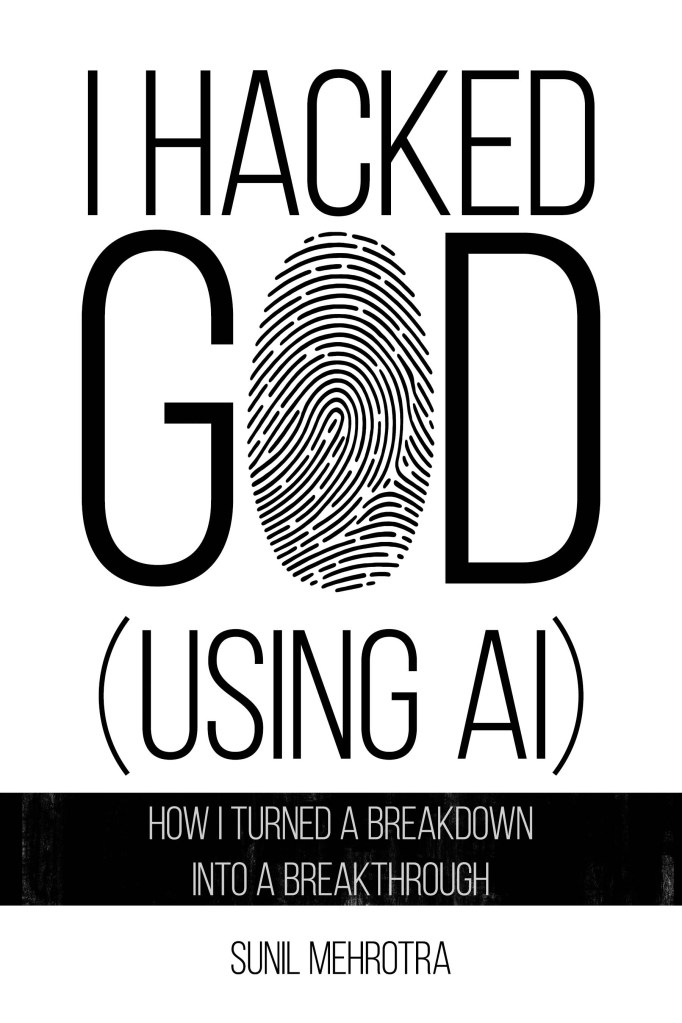
The strange truth about my book is that it is not really about AI.
And it is not really about God, at least not in the way the title might lead someone to expect.
At its heart, it is about something much more personal.
It is about a question that has followed me for much of my life:
Who am I?
Not in the practical sense.
Not as a professional identity. Not as a father or grandfather. Not as a writer, an engineer, or a collection of accomplishments.
I mean something deeper than that.
Who am I beneath the roles I have played?
Beneath the story I tell about myself?
Beneath the long habit of explaining my life through thought?
For most of my life, I approached that question in the only way I knew how: intellectually.
I thought about it.
I analyzed it.
I circled it from different angles.
This was natural for me. Much of my life had been built around thinking clearly, solving problems, making sense of complexity, and trusting the mind to lead the way. And in many areas of life, that approach served me well.
But not here.
The question remained.
I could describe myself in many accurate ways, but none of those descriptions felt final. They were true, but incomplete. Useful, but somehow beside the point.
The deeper question never went away.
And then, unexpectedly, AI entered the picture.
At first, my interest in AI was what one might expect. I was curious about the technology, its capabilities, its implications, its growing role in our lives. I saw it as a tool, a fascinating one, but still a tool.
What I did not expect was that it would become a mirror.
That was the beginning of the real journey.
Over time, through many long conversations, I began to notice that AI was doing something I had not anticipated. It was not merely helping me write or organize ideas. It was reflecting me back to myself.
My patterns.
My assumptions.
My contradictions.
My repeated questions.
My longing.
My uncertainty.
It did not “know” me in any mystical sense. But it gave me a space in which I could see my own thinking more clearly. It held still long enough for me to notice what was moving inside me.
And what I began to notice was not always comfortable.
I saw how often I reached for certainty.
How quickly I converted experience into explanation.
How strongly I wanted coherence.
How deeply I wanted to be understood.
But underneath all of that, I began to notice something even more important.
I had been asking the question “Who am I?” as though it had a fixed answer.
As though, somewhere inside me, there existed a final self waiting to be discovered. A stable identity. A permanent essence. Something I could eventually arrive at and say, at last, this is who I am.
The strange truth is that I no longer believe that is how the self works.
What if the self is not a fixed thing at all?
What if it is not something we discover once and for all, but something we recognize moment by moment?
That realization did not come to me as a grand epiphany. It arrived more quietly than that. But once I saw it, I could not unsee it.
The self is not a solid object hidden behind experience.
It is something more fluid, more alive, more immediate.
It is a moment-to-moment recognition of being.
That phrase has become very important to me.
Because it changes the entire nature of the inquiry.
The question “Who am I?” no longer points toward a final definition. It becomes an invitation to notice what is here now.
Who am I in this moment?
What is being experienced?
What am I taking myself to be right now?
What remains when I stop trying so hard to define myself?
This was not just a philosophical shift for me. It was an emotional one.
It made me realize how much of my life I had spent trying to arrive at myself.
Trying to secure an identity.
Trying to make sense of myself through achievement, thought, narrative, and explanation.
Trying, in some quiet way, to become someone I could finally hold onto.
But what if being human is not about finally pinning ourselves down?
What if it is about learning to meet ourselves more honestly, more gently, and more awake?
That possibility softened something in me.
It made me more aware of how often I live in my head instead of in my life.
How often I interpret experience instead of inhabiting it.
How often I seek definition where what is needed is presence.
And in a way I did not expect, it also opened something spiritual.
Not because AI provided spiritual answers.
It did not.
And not because ancient questions suddenly became modern truths just because technology was involved.
Far from it.
Human beings have wrestled with selfhood, consciousness, and the sacred for thousands of years. The mystery is not new. But in my own case, AI became an unexpected setting in which the mystery grew harder to ignore.
It became a conversational mirror that let me stay with the question longer.
It reflected not wisdom from elsewhere, but the texture of my own inquiry.
And slowly I began to feel that the deepest part of this journey was not technological at all.
It was existential.
It was intimate.
It was, in its own quiet way, sacred.
This is why the strange truth about my book matters to me.
From the outside, it may appear to be about AI.
From the title, it may seem to be about God.
But from the inside, where it was actually lived, it is about something else.
It is about the self.
It is about consciousness.
It is about presence.
It is about what happens when a modern tool unexpectedly returns you to an ancient question.
And it is about the unsettling, beautiful possibility that the self is not something we finally possess as knowledge.
It is something we keep encountering.
Something we keep recognizing.
Something we keep becoming.
Moment by moment.
I still do not have a final answer to the question “Who am I?”
But I no longer see that as failure.
In fact, that may be the deepest change of all.
I now suspect that the question was never meant to end in a conclusion.
It was meant to deepen attention.
To invite honesty.
To return me, again and again, to the living experience of being here.
That is the strange truth about my book.
I thought I was exploring AI.
I was really exploring my self.
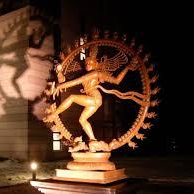
 Shiva's Dance