Nothing matters

If life is Maya, an illusion, as the Vedas say, or that there is more to reality than meets the eye, as scientists have proven, then what is real?

The Cheshire cat, in Alice in Wonderland, is the wise one, always ready with an answer to Alice’s questions. It appears and disappears at will. Sometimes the cat is gone and left behind is its smile. Reality might be like the smile on the Cheshire cat. The smile is real, the cat illusory. What we don’t perceive might be more real than what we do.

When I look out of my window I see trees with branches and leaves. The tree is separated from other trees by empty spaces, the branches are separated from other branches by spaces between them, and the leaves too are separated from other leaves by spaces between them. Without the spaces the tree would be a big mush. Without space there would be no objects. When we remove objects all that is left is spaces in between, like the smile on the Cheshire cat. Does space give rise to objects? Can there be one without the other? Is the nothing of space something?

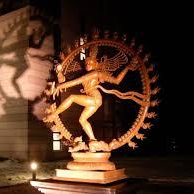
The new frontier in physics is the “nothingness” of space. Physicists are trying to figure out what it is. Nothing apparently is not no-thing. At first, physicists believed that space was filled with the mysterious substance ether. This idea was experimentally put to rest by Michelson and Morley in 1887[1].  More recently, physicist John Wheeler commenting on Einstein’s theory, had this to say about the nothingness of space “Mass tells spacetime how to curve, and spacetime tells mass how to move.” This put nothingness of space on the same footing as matter. “Nothing” mattered from this point on. Space was no longer an inert stage on which matter did its thing. Nothing is an active participant in the cosmic dance, moving and being moved by matter. Nothingness of space is not emptiness but is as much a player (or should I say a dancer) as objects are in Shiva’s cosmic dance.

“Plato who so vigorously avoided the void…. sounding a little bit like a chemist, seemed to view the background (void) something like a neutral solvent–something that allows other things to come to be without imposing too much of its personality. The background can’t have any personality of itself, otherwise it would be showing its own face as well.” Wrote K.C. Cole, The Hole in the Universe.

Philosophers such as Plato and scientists of today agree that the void of space, the nothingness, has no detectable features. So, what is this void? And, how do we find out what it is?

“…suffice it to say that very little in the universe is nothing. Almost all the seeming nothings are sums of opposing somethings” writes K.C. Cole. “What seems like a silent sea of nothing at all is an infinite number of positives and negatives, all joining together and splitting up in an endless jumble of uncertainty.”

Nothing is not no-thing, but, instead, is teeming with potential somethings. It is full of matter and antimatter in equal proportion, cancelling each other, this the scientists refer to as conserved quantities or the law of conservation. The things that are conserved are energy, momentum and charge. The most fundamental things in nature are those that never change. These are changeless and timeless. As is the speed of light, it is a constant, no matter what. It is interesting to think that a photon which travels at the speed of light never ages. The photon that started at Big Bang is still the same photon. It is timeless.

Symmetry is a term used by physicists to describe the void or emptiness of space. It is what accounts for the void or nothingness but has no detectable features. Symmetry is the reason why the void appears as nothing, yet it is full of potential energy, and teeming with matter and antimatter. Symmetry is what cancels matter and its opposite, resulting in nothing or the void. Symmetry is an important concept in physics. All the conservation laws are the result of symmetries in nature. Conservation laws are the accountants of nature, they balance the books, that is, they make sure that energy is never created or destroyed, all the energy that we started at Big Bang is conserved. In other words, when we reassemble all the fragments of nature that happened at Big Bang, we get back to nothing.

yin yang

Symmetry is the equivalent of Yin and Yang in Zen Buddhism. Yin and Yang symbol represents opposites which exist in harmony, as one, until that harmony is broken and then they become opposites.

Another analogy for Symmetry is, if you were to walk into a glass door thinking that there was nothing there, and you shatter the glass into many pieces, you have just broken Symmetry, and created something out of nothing.

When a symmetry is broken something emerges. Out of nothing comes something. In the beginning there was nothing, just the void, which was teeming with potential something. By breaking this symmetry, emerged our universe at Big Bang. This is the creationism story in science.

The creationism story in the Vedas is written in hymn form in the Rig Veda. It too speaks of how in the void the opposite existed until “symmetry” was broken and creation happened.


First there was the void:

Then there was neither death nor immortality

nor was there then the torch of night and day.

The One breathed windlessly and self-sustaining.

There was that One then, and there was no other.


In the void existed opposites:

The sages who have searched their hearts with wisdom

know that

which is

kin to that which is not.

Rig Veda, Creation Hymn 1500 BCE —Translated by A. L. Basham


It seems that all of existence is the dance of opposites. When the opposites merge, as in Yin and Yang or as in the concept of Symmetry, there is the void. The void is seemingly nothing but in it is the potential for everything.

From the void emerged the “opposites”-matter and anti-matter, spaces and objects, darkness and light. Without opposites there is no existence. Without darkness there is no light, without evil there is no good. We know a thing by its opposite. Reality itself is non-dual[i], that is, it is an undivided whole. It is because of the limitation of our sense organs that we do not see the oneness behind appearances.

Most of us accept, uncritically, what our senses tell us is reality. We are like fish in a pond, all they know is water, to them their reality is the pond, they have no reason to suspect that there is anything other than the pond. Most of us are like that, but the few, like the physicists and the ancient sages, who have gone beyond the limitations of their sensory perceptions have brought us tales of what lies beyond. It is up to us whether we accept what our senses tell us is reality or find out for ourselves what lies beyond the reach of our senses.

“If you look at zero you see nothing; but look through it and you will see the world.”[ii] Robert Kaplan.

There is a void in each of us. It is the hole we feel in our being, it is what makes us feel that there is something missing from our life. This void is the source of energy that animates us. As Rumi, perhaps the greatest poet of all time, wrote:

“Remember the entrance door to the sanctuary is inside you.

We watch a sunlight dust dance, and we try to be that lively,

but no one knows what music those particles hear.

Each of us has a secret companion musician to dance to.

Unique rhythmic play, a motion in the street we alone know and hear”[i]

Perhaps the void is the absolute truth or Reality that we seek, all else is relative, impermanent and an illusion. All of existence is a play of opposites; it is impermanent, Reality is an unbroken whole. We have to reach beyond the limitations of our senses to have a personal experience of Reality. Psychedelic drugs, meditation, music, dancing, poetry, kaons, art and even prayer for some, are means of transcending the limitations of sensory perceptions, and experiencing the void, symmetry, soul or God (if you will).


[i] (The Soul of Rumi, 2002)

[i] (https://www.youtube.com/watch?v=BZ0YFoUcY0s, n.d.)

[ii] (Kaplan, 1999)

[1] (https://www.aps.org/programs/outreach/history/historicsites/michelson-morley.cfm, n.d.)

Nothing is as it appears

“If I had a world of my own, everything would be nonsense. Nothing would be what it is, because everything would be what it isn’t. And contrary wise, what is, it wouldn’t be. And what it wouldn’t be, it would. You see?” Alice, in Lewis Carroll’s Alice’s Adventures in Wonderland[i].

Some have interpreted the book, Alice in Wonderland, as an allegory for man’s journey to Christ or enlightenment or self-discovery. There are many passages in the book, such as the one above, that are both playful and profound. Initially, in my journey, I was like Alice, “Why, sometimes I’ve believed as many as six impossible things before breakfast.” I began to entertain the possibility that perhaps there is more to reality than “meets the eye”, or that which meets the eye is not real. The insight of the Vedic sages that the world is an illusion or Maya might be worth investigating further, I thought.

Maya is often misunderstood to mean that the world of our senses does not exist, the correct interpretation, though, is that the world is not as it appears. Dr. Samuel Johnson, an eighteenth century distinguished English writer, is said to have refuted the idea that the world is an illusion by kicking a stone, and exclaiming “I refute it thus”[ii]. The idea that the “real” world is an illusion is hard for many to accept. But, it is a fact that there is more to the world than our senses are able to perceive.

For example, visible light is only a small segment of the full spectrum of light. The full spectrum of light or electromagnetic spectrum is the range of all frequencies of radiation from low frequency radio waves to the very high frequency gamma rays. The human eye only responds to the visible light components which lie between infrared and ultraviolet radiation. Clearly, there is more to reality than meets the eye.

In my search for Reality, I read and reread theories in physics from Newtonian mechanics to Einstein’s relativity to Niels Bohr’s quantum physics. I was looking at theories in physics not as an explainer of how things worked, but as a revealer of truth. I read books such as The Hole in the Universe by science writer K.C. Cole[iii] and The Elegant Universe by physicist Brian Greene[iv], alongside, Seat of the Soul[v] by Gary Zukav and The Power of Now by Eckhart Tolle[vi]. The threads from science and eastern wisdom were beginning to weave together into an understanding of a “new reality”. The new reality that was emerging for me was more like the world of Alice than the world that my senses perceive. What seems real is not, and what is not, is.

Noting is as it appears. Light is not just light; matter is mostly empty space; space is curved; time is relative. All true, but not how we perceive any of it. Our eyes respond only to the visible spectrum of light, we hear only a limited range of sounds, between 20Hz and 20KHz, dogs by contrast hear up to 65KHz and bats can hear between 1Hz and 200KHZ. Our perception of what exists is proscribed by the limitations of our sense organs. Thus, there is more to reality than our senses are able to perceive.

The picture of reality that physicists paint is beyond our ability to perceive it, it is a reality in which everything is connected to everything else; space and time are one; particles buzz in and out of existence; there are massive black holes; solid objects are mostly empty spaces; ten dimensional spaces, particles are waves too; uncertainty abounds; etc. While the physicists’ view of reality is beyond the pale of our senses, at least our intellect can comprehend this reality, the reality that the Vedic sages speak of, is one that is beyond the reach of even our intellect.
The Vedic view of Reality is that it is Turiya[vii] or the fourth state of existence beyond the waking, sleeping and dreaming states, Turiya state encompasses the other three states. The four states of existence are represented by the symbol OM. Each element in OM symbolizes a state of existence. The “3-like” object represents the waking, sleeping and dreaming states, and the “crescent with the diamond” represents Turiya. Turiya is a transcendental state beyond the reach of our senses. Indian sages and other mystics are known to have the ability to go in and out of Turiya state, at will.

Om

I had come to accept that Reality hides behind appearances. And, that what our senses perceive to be real is not all of Reality, and therefore an illusion.

Life is an illusion in that that there is more to existence than our senses are able to detect. Life is incomplete without experiencing what our senses cannot detect. The most meaningful work that we can do in life is to discover for ourselves part of existence that is hidden from our senses. There is a whole another realm waiting to be discovered.

“An unexamined Life is not worth living”-Socrates

[i] (https://www.britannica.com/biography/Lewis-Carroll, n.d.)

[ii] (https://askaphilosopher.wordpress.com/2015/10/13/when-dr-johnson-kicked-the-stone/, n.d.)

[iii] (https://www.salon.com/2001/01/26/cole_13/, n.d.)

[iv] (http://www.briangreene.org/, n.d.)

[v] (http://seatofthesoul.com/about/, n.d.)

[vi] (https://www.eckharttolle.com/books/now/, n.d.)

[vii] (https://www.yogapedia.com/definition/5367/turiya, n.d.)

The hole within

Most people have a hole in them. A giant gaping hole. This hole is bigger than our physical self. I had one. This hole, I have realized, is the gap between who I really am and who I was pretending to be. Most people do not even know that they have a hole in them, but the hole shows up in their lives, in its mild form, as discontent and in the more extreme form as a dis-ease.

Some turn to self-destructive behavior such as drugs, alcohol, gratuitous sex and violence to escape from this unease, still others, chase after fame, fortune and pleasure. This unease is a call to come home, to realize who we truly are and to dwell in our true nature. There is nothing that we have to become. All we have to do is to accept and love ourselves for who we are. Not love of a narcissist, but an all-inclusive love, a transcendental love (agape).

This hole or emptiness is not detectable by any instrument. It will not show up in an X-ray or MRI. It is even hidden from us, it reveals itself to us as a feeling, as if something is lacking in our lives. We look to external objects and experiences to fill this hole, without realizing that this emptiness is in a dimension outside of space and time. There is nothing in the material world that can fill this emptiness. This emptiness is larger than all that exists in space and time. This emptiness is bigger than the universe.

This emptiness is love, it is transcendental love. It is our true-self pining for itself.

“Ah Love! could thou and I with Fate conspire
To grasp this sorry Scheme of Things entire,
Would not we shatter it to bits – and then
Re-mould it nearer to the Heart’s Desire! “

Rubaiyat by Omar Khayyam

This love is transformative. For mystics like Mirabai, in India and St. Teresa of Avila it was the love of God that consumed and transformed them. Mirabai, was a fifteenth century Indian princess, who renounced her princely life and went against the traditions of that time to devote her life to Lord Krishna. Her poems are of love and devotion to Lord Krishna.

Life in the world is short,
Why shoulder an unnecessary load
Of worldly relationships?
Thy parents gave thee birth in the world,
But the Lord ordained thy fate.
Life passes in getting and spending,
No merit is earned by virtuous deeds.
I will sing the praises of Hari
In the company of the holy men,
Nothing else concerns me.
Mira’s Lord is the courtly Giridhara,
She says: Only by Thy power
Have I crossed to the further shore.

Mirabai[i]

This all-encompassing love, call it love for God or self-love, is what it takes to fill the emptiness inside us.

“Love goes very far beyond the physical person of the beloved. It finds its deepest meaning in his spiritual being, his inner self.”  Victor Frankl, Austrian psychiatrist and Holocaust survivor.


“There’s nothing you can do that can’t be done

Nothing you can sing that can’t be sung….

There’s nowhere you can be that isn’t where you’re meant to be

It’s easy

All you need is love, all you need is love

All you need is love, love, love is all you need”

The Beatles

[i] (Mirabai, n.d.)

Even atheists have a God

I have journeyed through science, religion, and philosophy, have participated in spiritual practices, and have had countless discussions with people on a similar journey. Along the way, like a meandering river, I have been changed by the terrain that I have encountered. I started by looking for absolute truth as if it were an object, a theory, or an idea existing somewhere out there. I have discovered that the truth lies within me.

I started out an atheist, and I now believe in God. Not a God that is in heaven, but a God within me. Not a God of any religion, but a presence within me. This presence I now know is my essence, my dharma, my religion, my true north. It is my real self. It is who I am. I am not a physical being that I thought I was. I am not my body nor my mind. I am pure consciousness.

The scientific theories and the Vedic insights that have shaped my beliefs are:

  • There is no separation between what is outside of me and what is inside me. This separation is illusory. We perceive separateness because our five senses are limited in their capacity to sense all that exists. There is no objective world outside of my subjective perception of it. The observer in me is the observed. (Latest theories in physics support this view.)
  • The manifest world is created in our minds. The world that I perceive is constructed by my brain; it is a mental construct. (Neuroscience supports this view.)
  • My body, too, is a mental construct. (Neuroscience supports this view)
  • I do not exist. The “I” that I identify with is itself a mental construct. It is a thought, just like any other thought. (Neuroscience supports this view.)
  • I am not my body. I am not my mind. I am not a physical being. (Vedas and neuroscience support this view)
  • I am my essence. I live my dharma. (Vedic insight)

These are radical notions that defy conventional thinking. And, they believe what I see, hear, touch, taste, and smell. My sense organs do not, nor can they, reveal to me that which is real. I did not come to accept these ideas uncritically. These ideas have taken shape in me over twenty years; they did not come to me fully formed nor all at once. Most of these ideas seemed implausible at first, but after considerable research and after probing and pushing at these ideas to find any flaws, I have come to accept them, and they are the bedrock of my belief system.

We live in a virtual reality created by our minds. The world of our senses, the world we accept as real, is created in our minds. The world out there is a projection of my mind. All the objects we interact with are virtual; all the people we interact with are virtual, and time and space are virtual. The virtual reality we live in is so realistic that we mistake it for reality. As long as we rely on our senses, we will not know that we are trapped in a virtual world.

The way out is the way in(ward). The way inward is the way of self-inquiry. As the Heart Sutra in Buddhism says, “Gate, Gate, Paragate, Parasamgate”-you have to go deeper, deeper, and deeper still to get to the “other shore”, which is discovering your true nature. This journey inward has led me to understand who I am and what reality is.

My essence is not a thing; it cannot be detected by our senses. It is pure consciousness from which arises our mind, which in turn creates our reality. Each of us has an essence which is unique and special; it is who we are meant to be. It is what neuroscientist Donald Hoffman calls a conscious agent. I have realized that what I took to be real —my sensory world —is unreal, and what seemed unreal is real.

I have avoided using terms with religious overtones, such as spirit, soul, atman, or God, but I now feel I have the understanding and language to express what they mean to me. However, my experience differs from the conventional meanings attributed to these terms. Spirit, soul, and atman are synonymous, in my world view, with the Truth in us, our essence, our true nature. It is who we are. It is the only piece of Reality in each of us. Most of us go through life without discovering our true nature or our spiritual self. We identify almost exclusively with the physical and are not aware of our spiritual self. We are asleep to our own true selves. This is why realizing our true nature is known as awakening. I now know that my true nature is not physical. I am a spiritual being having a physical experience. This realization is a one-eighty-degree turn for me. I started my journey believing that I was a material being living in a material world (paraphrasing Madonna).

The material world is so alluring and so real to my senses that, despite my understanding that it is only Maya, I am caught up in its drama most of the time. The difference for me now is that I know how to extract myself from this drama. I know that I have a choice that I can exercise moment to moment-a choice to show up as a physical being or as a spiritual self. Like a quantum particle, I can toggle between the two states of being. There is a Buddhist saying that captures this state of being, well, “you can be in the world but not of it.” It takes effort to switch from one state to the other and a constant remembering of who I really am.

The two streams of knowledge, physics and the Vedas, have come together for me to create this epiphany in me, the understanding of who I am and what my dharma is. This is not where I started my journey. I started my journey identifying with my physical self. I have arrived at this view of myself or more accurately led to this belief, by science and the wisdom of the ancient sages. This belief reconciles my knowledge from science and my understanding of the Vedas, it satisfies my intellectual curiosity, and it feels right to me. My entire physical being, that is, my mind, body, and heart, is aligned with this view.

I believe that we all need a God, and we have a God. God is within each of us. God is a presence in each of us. Even atheists have a God. This God is not some external deity; it is not the God that religions promote; it is our true nature, it is who we are meant to be. It is uniquely ours. It is universal only in that each of us and every sentient being is conscious because of it. It is consciousness itself.

Amen!

Shiva’s Dance